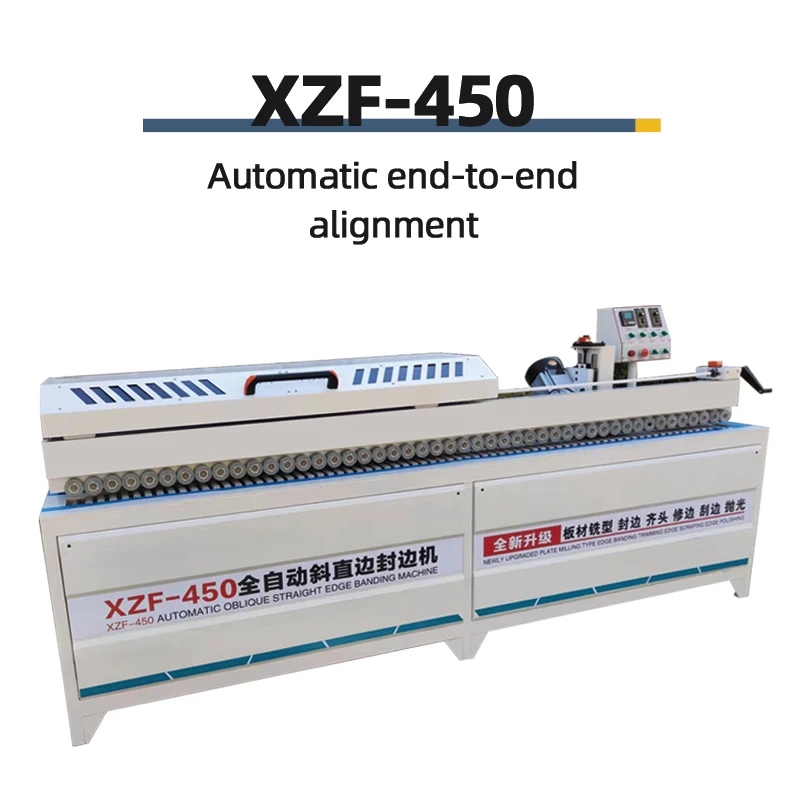
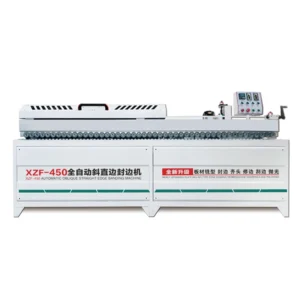
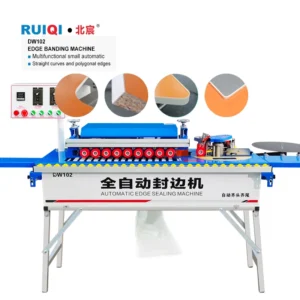
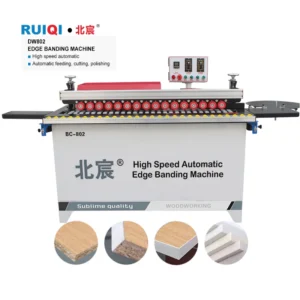
Verified Tolerance — precision-ground components and a four-stage QC process hold the XZF-450 to ±0.02mm edge alignment, checked before dispatch.
Technical Specifications
| Parameter |
Value |
| Model |
XZF-450 |
| Product Type |
45 Degree Automatic Edge Banding Machine |
| Total Power |
9.5 kW |
| Pre-milling Motor |
4 kW |
| Edge Trimming Power |
2.2 kW × 2 |
| Polishing Power |
0.4 kW × 2 |
| Edge Feeding Power |
0.16 kW |
| Transmission Power |
180 W |
| Vacuum Power |
550 W |
| Voltage |
380V / 415V (basis to be confirmed for 50Hz or 60Hz) |
| Feed Speed |
0–12 m/min |
| Edge Banding Height Range |
0–50 mm |
| Edge Banding Thickness Range |
0.3–3 mm |
| Minimum Sheet Length |
30 cm |
| Minimum Sheet Width |
15 cm |
| Glue Pot Capacity |
4000 ml |
| Air Source Pressure Requirement |
0.5–0.7 MPa |
| Standard Functions |
Plate pre-milling, 30°/45°/60° angle edge banding, end trimming, rough trimming, fine trimming, scraping, polishing, dust extraction |
| Overall Dimensions (L×W×H) |
300 × 65 × 135 cm |
| Net Weight |
430 kg |
| Language Options |
Chinese and English standard; other languages available on request (basis not stated in source) |
| Plug Options |
EU, USA, AU, UK (basis not stated in source) |
Application Suitability
| Application |
Material or Output |
| Custom cabinet manufacturing |
MDF and melamine board edge banding |
| Joinery workshop production |
Plywood and particleboard panel processing |
| Furniture component finishing |
Solid wood board and blockboard edging |
| Polymer door panel fabrication |
Polymer and veneer edge banding materials |
Why Voltage Verification Must Precede Your Edge Banding Machine for Small Workshop Order
A machine wired for the wrong supply sits dead on arrival, turning a capital investment into a three-week floor obstacle.
I once arranged shipment of a compact bander to a carpentry shop in Lagos without confirming their breaker panel. The shop ran on 220V single-phase, but the machine was built for 380V three-phase. The motor burned out during the first power-on test, and the shop waited weeks for a replacement unit while production stalled. That failure was entirely preventable. Small workshops in regions with mixed electrical infrastructure often discover their supply limitations only after the crate arrives. [NEED_CITE: voltage and frequency standards by export market]

Multi-Angle Banding Without a Second Station
This edge banding machine for small workshop use handles 30°, 45°, and 60° angle banding alongside standard 90° edges within a single pass. A joinery shop producing angled cabinet carcasses or beveled furniture components does not need to purchase a separate angle-banding attachment or run panels through twice. The XZF-450 switches between angles through mechanical adjustment at the banding head, keeping the machine footprint at 300 cm while covering geometries that typically require dedicated stations.
Pre-Milling Included as Standard Equipment
The 4 kW pre-milling motor removes saw marks and minor edge imperfections before the glue application stage. Entry-level banders often skip this station, leaving visible glue lines on MDF and particleboard where the substrate surface is uneven. With pre-milling built into the XZF-450 sequence, panels move from rough-cut to polished edge in one continuous feed, eliminating the need for a standalone milling station. [NEED_CITE: substrate preparation requirements for adhesive bonding on engineered wood panels]
How Feed Speed and Pressure Shape Edge Quality
The adjustable feed speed range of 0–12 m/min lets operators slow the transmission when running thicker banding materials or unfamiliar substrates. At higher speeds, the edge trimming and scraping stations must remove more material per unit of time, which can leave chatter marks on softer PVC banding. The 0.5–0.7 MPa air pressure requirement drives the pneumatic pressure rollers that hold the banding against the panel edge during glue curing — insufficient pressure produces hollow spots, while excess pressure squeezes adhesive past the banding edge. The 4000 ml glue pot capacity supports continuous runs without mid-batch refills, keeping glue temperature stable across a full day's panel output.
The Hidden Cost of Skipping Configuration Checks
Ordering a bander without confirming the minimum sheet dimensions against your actual panel sizes leads to processing failures on smaller workpieces. The XZF-450 requires a minimum sheet length of 30 cm and width of 15 cm — panels smaller than this cannot be gripped securely by the feed chain, producing skewed banding and damaged edges. Similarly, specifying a machine without confirming the edge banding thickness range against your supplier's available stock means discovering mid-production that the 0.4 mm PVC your vendor carries falls outside the machine's capability. These mismatches surface only after installation. [NEED_CITE: edge banding material compatibility with automated feeding systems]
Why Procurement Through This Channel Works
Engineer-led configuration means your workshop's panel mix and daily volume drive the quotation, not a catalogue default. The XZF-450 ships with a factory test record showing edge finish quality on your specified substrate before dispatch. Voltage and plug customization are confirmed at the quotation stage, not discovered at unpacking. The four-stage QC process covers incoming component inspection through pre-shipment verification, so tolerance holds at ±0.02mm when the machine arrives. Spare parts lists and consumable specifications travel with the machine, not as a separate request weeks later.
Documentation & Verification
- CE declaration of conformity covering machinery directive requirements
- Machine specification sheet confirming voltage, frequency, and plug type for your market
- Factory test record with photographs of edge finish on your panel material
- Operation and maintenance manual in your confirmed language
- Electrical schematic matching the as-built control panel configuration
Installation, Commissioning & Support
- Requires a dedicated circuit rated for 9.5 kW total draw at the confirmed voltage
- Overall length of 300 cm demands clear floor space plus operator access on both sides
- 430 kg net weight requires level concrete flooring with anchor bolt provision
- Pneumatic line must deliver 0.5–0.7 MPa clean dry air to the machine inlet
- First commissioning includes feed speed calibration and pressure roller adjustment for your banding material
- Spare parts list identifies wear items with replacement intervals for the glue pot and scraping blades
What We Need to Configure Your Machine
Send your workshop's electrical supply photograph showing the breaker panel and voltage rating, along with the frequency standard for your region. Specify the panel materials you process most often — MDF, plywood, melamine board, or solid wood — and the edge banding thickness range your suppliers carry. If you run angled components, confirm which angles appear in your production. These details let us match the XZF-450 configuration to your actual conditions before quotation.
Frequently Asked Questions
Q: What panel and edge banding dimensions does the XZF-450 accept?
A: The machine handles edge banding heights from 0 to 50 mm and banding thickness from 0.3 to 3 mm, covering standard PVC, ABS, and veneer materials. Minimum sheet dimensions are 30 cm length and 15 cm width. Panels smaller than these minimums cannot be fed reliably through the chain transport system.
Q: Can the voltage and plug match my workshop's electrical supply?
A: Voltage is configurable at 380V or 415V, with plug options for EU, USA, AU, and UK standards. Frequency must be confirmed as 50Hz or 60Hz for your region before production begins. We request a photograph of your breaker panel to verify compatibility before the order is finalized.
Q: What happens when production volume outgrows this machine?
A: The XZF-450 sits within a broader equipment range that includes higher-throughput models with additional processing stations. When your daily panel count consistently exceeds what a 0–12 m/min feed speed supports, the transition path moves to a full-line automatic bander without changing your supplier relationship or retraining on a different control system.
Q: How do I verify edge quality on my specific board material before ordering?
A: We run a sample processing test using your actual panel material and edge banding stock, either through a factory visit or by shipping sample panels back to you. The factory test record documents edge adhesion, trimming accuracy, and surface finish on your substrate before the machine is cleared for dispatch.