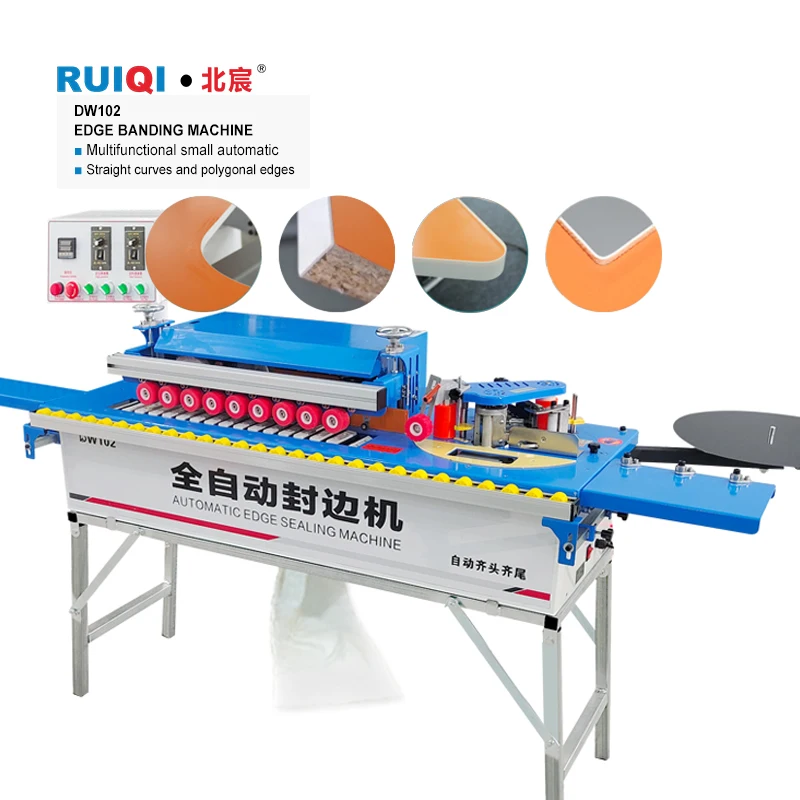
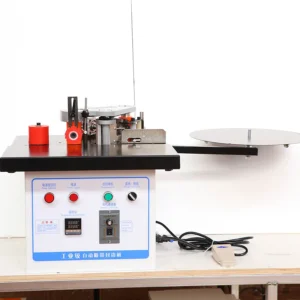
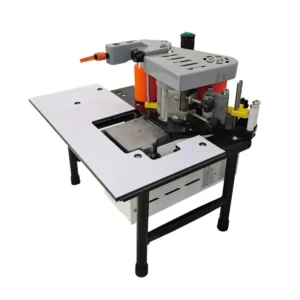
Compact Footprint, Complete Process — The DW102 integrates gluing, trimming, polishing, and vacuum extraction into a single 128×47×69 cm chassis, eliminating the need for small workshops to juggle multiple freestanding stations during early production scaling.
Technical Specifications
| Parameter |
Value |
| Model |
DW102 |
| Product Type |
Automatic Edge Banding Machine |
| Total Power |
3800W |
| Voltage & Frequency |
220V/380V, configurable (confirm 50Hz/60Hz before order) |
| Edge Banding Mode |
Curved and straight edge, automatic head-and-tail cutting |
| Edge Banding Height |
0–50 mm |
| Edge Banding Thickness |
0.3–3 mm |
| Minimum Sheet Length |
25 cm |
| Minimum Sheet Width |
5 cm |
| Glue Pot Capacity |
1500 ml |
| Trimming Power |
650W×2 |
| Polishing Power |
180W×2 |
| Vacuum Power |
1200W |
| Air Source Pressure |
0.5–0.8 MPa |
| Overall Dimensions (L×W×H) |
128×47×69 cm |
| Net Weight |
75 kg |
| Control System |
PLC (confirm model/brand at quotation) |
| Language Options |
Chinese, English, customizable to Spanish and other languages |
| Plug Options |
EU, USA, AU, UK |
| Assembly State |
Fully assembled (verify against manufacturer catalog) |
| Certification |
CE (verify unit-level documentation), ISO 9001 (manufacturer level) |
Application Suitability
| Application |
Material or Output |
| Small joinery workshop edge finishing |
MDF, blockboard, solid wood panels with PVC or veneer banding |
| Custom cabinet door production |
Particleboard and plywood panels, straight and curved profiles |
| Startup furniture maker first automation step |
Polymer door panels and laminated boards up to 50 mm edge height |
| Low-batch bespoke shelving and desk tops |
Wood panels requiring curved edge contouring with 0.3–3 mm banding |
Why the Voltage Question Should Come Before the Price
An automatic edge banding machine for small workshop use is only as ready as the electrical supply it meets on arrival.
I once shipped a unit to a cabinet maker in Chile who had confirmed 220V on the phone — but his workshop ran on 220V/60Hz, a frequency mismatch that kept the motor from starting. The operator stood in front of a silent machine for three weeks while replacement components were arranged. Small workshops do not have a second line to fall back on while they wait [NEED_CITE: voltage and frequency standards by export market]. When an Automatic Edge Banding Machine for small workshop environments arrives unusable, the loss is not just shipping time — it is lost contracts, idle labor, and credibility with end customers who were counting on delivery dates.

Built Around the Workshop That Cannot Afford Downtime
The DW102 is configured so a joinery operation moving off hand-trimming can start producing finished panels on day one, not after a week of electrical retrofitting. Voltage is set at the factory based on your confirmed grid supply — 220V or 380V — and the plug format ships matched to your country standard, whether EU, USA, AU, or UK. The PLC control panel is specified in the language your operator actually reads, removing the guesswork that stalls commissioning on machines with fixed Chinese-only interfaces.
Scaling Without Replacing the Entire Line
A compact automatic edge bander should not become obsolete the moment order volume grows. The DW102 handles edge heights from 0 to 50 mm and banding thicknesses from 0.3 to 3 mm, which covers the PVC and veneer materials most custom furniture startups work with across their first several years of operation. When throughput eventually demands a larger machine, the DW102 remains useful as a secondary unit for curved-edge jobs or short-run special orders [NEED_CITE: equipment lifecycle planning for growing furniture workshops]. That reassignment path is something piecemeal machine purchases rarely offer.
Reading the Numbers That Matter at Bench Scale
The 1500 ml glue pot capacity means operators in a small workshop are not interrupting runs every twenty minutes to refill adhesive — a frequent frustration with benchtop units that undersize the reservoir. The dual 650W trimming motors provide sufficient torque for clean cuts on both PVC and wood veneer banding, which directly affects the visible glue line quality your customer sees on the finished panel. Integrated 1200W vacuum extraction pulls dust and offcuts away from the banding path, reducing the surface contamination that causes adhesion failures downstream. The 0.5–0.8 MPa air pressure requirement is within the range of standard workshop compressors, so no dedicated high-pressure supply line is needed to get the machine running.
The Cost of Skipping Specification Verification
Workshops that order a compact edge bander on price alone often discover the mismatch only after unpacking. A control panel in an unreadable language means the operator cannot adjust feed parameters or diagnose fault codes, turning minor stoppages into day-long delays. An underspecified voltage configuration can damage the motor permanently, and warranty claims on electrical damage are difficult to resolve across borders [NEED_CITE: CE machinery directive requirements for industrial equipment]. The DW102 addresses each of these failure points through pre-shipment confirmation rather than post-delivery troubleshooting.
What Sets This Purchase Path Apart
Every DW102 order begins with voltage and frequency verification against a photograph of your workshop distribution board, not just a checkbox on an order form. The control panel language is confirmed before production, so the operator who will run the machine daily can read every menu item from the first hour. A sample processing test using your actual panel material and banding stock can be arranged before you commit to the order, giving you verifiable edge quality rather than a catalog claim. The machine ships with an operation manual written in your agreed language and a spare parts list covering the trimming blades, glue pot components, and polishing pads most likely to need replacement during the first year.
Documentation & Verification
- CE declaration of conformity for the DW102 unit with applicable machinery directive references
- Electrical schematic confirming your specified voltage, frequency, and plug configuration before build
- Factory test record on your exact panel thickness and banding material combination prior to dispatch
- Operation and maintenance manual produced in English, Spanish, or your specified language
- Spare parts list with part numbers for trimming blades, polishing pads, and glue pot seals
Installation, Commissioning & Support
- Overall footprint of 128×47×69 cm fits against a standard workshop wall without dedicated floor anchoring
- 3800W total power draw requires a dedicated circuit rated for continuous duty at your confirmed voltage
- Machine ships fully assembled — no on-site mechanical assembly beyond utility connections and leveling
- 0.5–0.8 MPa air supply connects to standard workshop compressor with no special pressure regulator needed
- 1500 ml glue pot should be filled with adhesive matched to your primary banding material before first run
- Trimming blades and polishing pads inspected for shipping alignment before operator training begins
What to Prepare Before Requesting a Quotation
Send a photograph of your workshop electrical distribution board so voltage and frequency can be confirmed against local supply standards. Specify the panel materials you work with most often, the edge banding thickness range you need, and the language your operator reads — these three details determine the exact build configuration of the DW102 before it enters production.
Frequently Asked Questions
Q: Is the DW102 sized correctly for my current panel volume, or should I look at a higher-tier model?
A: The DW102 suits workshops processing low-to-medium batch volumes where floor space is limited and the priority is replacing manual edge work with a single automated station. If your daily output regularly exceeds what a compact footprint can cycle through, a higher-tier model with faster feed rates and additional trimming stations would serve you better. Share your typical weekly panel count and we can confirm the right tier.
Q: What voltage and plug format do I need to specify for my country?
A: Send a photograph of your workshop distribution board or a utility bill showing supply voltage and frequency. The DW102 is configurable for 220V or 380V and ships with EU, USA, AU, or UK plug formats. We confirm the exact electrical configuration in writing before the machine enters production to prevent arrival-unusable scenarios.
Q: Can the control panel be set to a language my operator can read?
A: Yes. The PLC interface on the DW102 is available in English and Chinese as standard, and can be customized to Spanish or other languages at order stage. We confirm the language requirement in the quotation so the panel is configured before the machine leaves the factory, not reprogrammed on site.
Q: How do I plan an upgrade path as my production volume grows?
A: The DW102 covers straight and curved edge banding with PVC and veneer up to 3 mm, which serves most small workshop needs through early growth. When volume eventually requires a faster machine, the DW102 can be reassigned to curved-edge or short-run work rather than retired. We can discuss your projected growth timeline at quotation stage.
Q: What does the installation footprint and utility requirement look like in a small workshop?
A: The DW102 occupies 128×47×69 cm and weighs 75 kg, requiring a level floor area with clearance for panel feeding on one side. It draws 3800W total and needs a dedicated circuit at your confirmed voltage plus a standard compressed air supply at 0.5–0.8 MPa. No special foundation or three-phase supply is required for the 220V configuration.