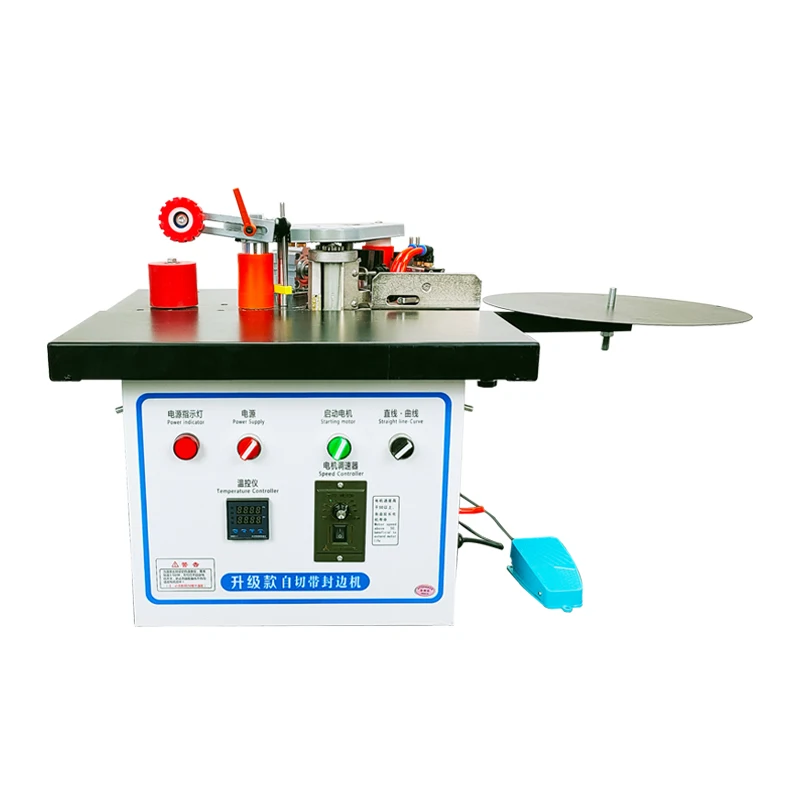
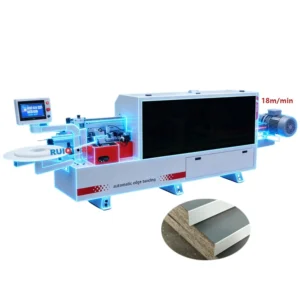
Fast Dispatch for Small Shops — This ST-50 portable edge bander ships as a single unit, ready for a joinery workshop moving off manual trimming without waiting for a full-line order.
Technical Specifications
| Parameter |
Value |
| Model |
ST-50 |
| Product Type |
Portable Edge Banding Machine |
| Total Power |
1000W |
| Voltage |
220V / 380V / customization |
| Edge Banding Height |
0-50mm |
| Edge Banding Thickness |
0.3-3mm |
| Minimum Sheet Length |
25cm |
| Minimum Sheet Width |
3cm |
| Glue Pot Capacity |
1000ml |
| Edge Motor Power |
20W |
| Air Source Pressure |
0.5-0.8MPa |
| Product Dimensions |
50 × 50 × 47cm |
| Product Weight |
22kg |
| Key Features |
Curved and straight edge banding |
Application Suitability
| Application |
Material or Output |
| Small workshop furniture edging |
MDF and particleboard panels |
| Home decoration on-site finishing |
Plywood and ecological board |
| Repair and rework of cabinet edges |
PVC and veneer edge banding strips |
| Custom shelving and joinery trim |
Solid wood board up to 50mm height |
Why Voltage Confirmation Matters Before You Hit "Ship"
A portable edge banding machine in stock ships fast — but only if the voltage matches your workshop's actual supply.
A small carpentry shop in a region running 220V single-phase once received a unit wired for 380V three-phase. The machine sat idle while an electrician sourced a transformer, delaying production by weeks. When you order a Portable Edge Banding Machine in stock or for fast delivery, the first question should not be about price or lead time. It should be about what comes out of the wall socket. [NEED_CITE: voltage and frequency standards by export market]
I spent years in the assembly hall tuning these units before moving into technical sales. The most frustrating callback is not a mechanical fault — it is a machine that powers on but cannot hold the glue pot at temperature because the voltage sag under load was never accounted for. Confirming electrical specs up front takes minutes and prevents weeks of downtime.

Smallest Viable Setup for a Growing Workshop
When a joinery shop transitions from hand-trimming to machine-assisted edge banding, the priority is a unit that fits the existing bench space and handles both straight runs and curved cabinet parts. The ST-50 covers that gap. At 50 × 50 × 47cm and 22kg, it sits on a workbench and moves between job sites. The 0.3-3mm banding thickness range takes standard PVC and thin veneer, which covers the majority of small-batch custom work. This Portable Edge Banding Machine in stock configuration is meant for operators who need results today, not a production line next quarter.
Curved Edge Work Without a Second Machine
Many entry-level edge banders handle straight panels only, forcing a small shop to buy a separate router jig or hand-trim curved pieces. The ST-50 bands both curved and straight edges in a single pass. For a cabinet maker producing radius-front base units or rounded shelf ends, that eliminates a bottleneck. The 25cm minimum sheet length and 3cm minimum width also mean small offcuts and narrow drawer fronts can be edged without manual clamping tricks. [NEED_CITE: common edge banding challenges for curved panel profiles]
What the Numbers Actually Mean on the Shop Floor
The 0-50mm edge banding height determines the thickest panel this unit will accept — standard 18mm MDF and 25mm particleboard sit well within that envelope, while thicker solid-wood worktops approach the upper limit. The 1000ml glue pot capacity allows extended runs without pausing to refill, which matters when a single operator is edging a full kitchen run of cabinets. Air pressure at 0.5-0.8MPa drives the feed and pressure rollers; a small workshop compressor rated for continuous duty at that pressure is a prerequisite. The 0.3-3mm banding thickness range means the same glue temperature setting can handle both 0.4mm PVC for shelving and 2mm solid-wood lipping for countertop edges, though the operator must adjust feed speed between the two. Total power draw at 1000W keeps the unit on a standard single-phase circuit without a dedicated breaker in most workshop panels.
The Cost of Skipping the Compatibility Check
Buying a single portable edge banding machine in stock without verifying how it integrates with the rest of the workflow leads to compounding problems. A unit that cannot match the feed height of an existing table saw forces the operator to manually lift panels into position, introducing edge misalignment. Inconsistent glue temperature from an unverified power supply causes adhesion failure on melamine-faced board, and the operator blames the adhesive rather than the voltage drop. These faults surface weeks after delivery, once the initial test cuts are forgotten and real production volume begins. [NEED_CITE: common causes of edge banding adhesion failure in small workshops]
Why Source This Unit Through RuiqiShop
Every ST-50 leaving the facility ships with a pre-shipment test record run on the buyer's specified panel material, so the glue temperature and feed speed are documented before packing. Voltage is confirmed and matched to the destination market before the machine leaves the floor, eliminating the transformer problem described earlier. The operation manual is supplied in the operator's language — not a generic translation — covering glue pot maintenance and banding thickness adjustment specific to this model. Single-unit orders are accepted with the same documentation package as a container load. Dispatch lead time is quoted at the point of order confirmation, not buried in fine print.
Documentation & Verification
- Pre-shipment test record using your specified panel thickness and edge banding material
- Electrical schematic confirming voltage and plug type matched to destination country
- Operation manual in agreed language covering glue pot settings for 0.3-3mm banding range
- Spare parts list with part numbers for glue pot, feed rollers, and trimming blade
- Packing photographs of the specific unit before crate closure
Installation, Commissioning & Support
- 22kg unit requires a stable workbench rated for at least 50kg to absorb feed vibration
- 1000W total draw runs on a standard 220V circuit; confirm amperage at the breaker panel
- Air line at 0.5-0.8MPa must connect to a compressor with continuous duty rating
- Glue pot first fill and temperature calibration performed by operator before first production run
- Trimming blade and feed roller inspection recommended after every 200 linear meters of banding
- Spare glue pot and replacement rollers stocked for same-week dispatch on request
Getting Your Configuration Right
To match this Portable Edge Banding Machine in stock to your workshop, send through the panel materials you run most often, the edge banding thickness and type you stock, and your local voltage and plug standard. If your shop handles curved cabinet components, confirm the minimum radius you typically produce so the feed path can be verified against that geometry before dispatch.
Frequently Asked Questions
Q: What voltage and plug options are available for my country?
A: The ST-50 is configurable for 220V or 380V supplies, with plug type matched to the destination market. Voltage and frequency are confirmed before production so the unit arrives ready to connect. A dedicated circuit is recommended for stable glue pot temperature under continuous use.
Q: Can the control panel be supplied in English or other languages?
A: Yes. The operation manual and any control labeling are prepared in the language agreed at order confirmation. This covers glue pot temperature settings, feed speed adjustment, and safety instructions specific to the ST-50 portable configuration, so operators can commission the unit without external translation.
Q: What panel materials and edge banding types does this machine handle?
A: The ST-50 processes MDF, particleboard, plywood, ecological board, and solid wood board with edge banding thickness from 0.3mm to 3mm. This covers standard PVC strips and thin veneer. Glue pot temperature must be matched to the specific adhesive and banding material in use for reliable adhesion.
Q: What is the dispatch lead time for a single-unit order?
A: Single-unit orders are accepted with dispatch timing quoted at order confirmation. The unit ships with a pre-shipment test record, voltage verification, and language-specific documentation. Fast delivery depends on stock position at the time of inquiry, which is confirmed before payment is requested.
Q: How do I confirm the machine fits my current workshop workflow?
A: Share your primary panel dimensions, edge banding material, and existing equipment layout. The 25cm minimum sheet length and 3cm minimum width define the smallest workpiece this unit accepts. We verify feed height compatibility and curved-edge radius capability against your production mix before the order is finalized.