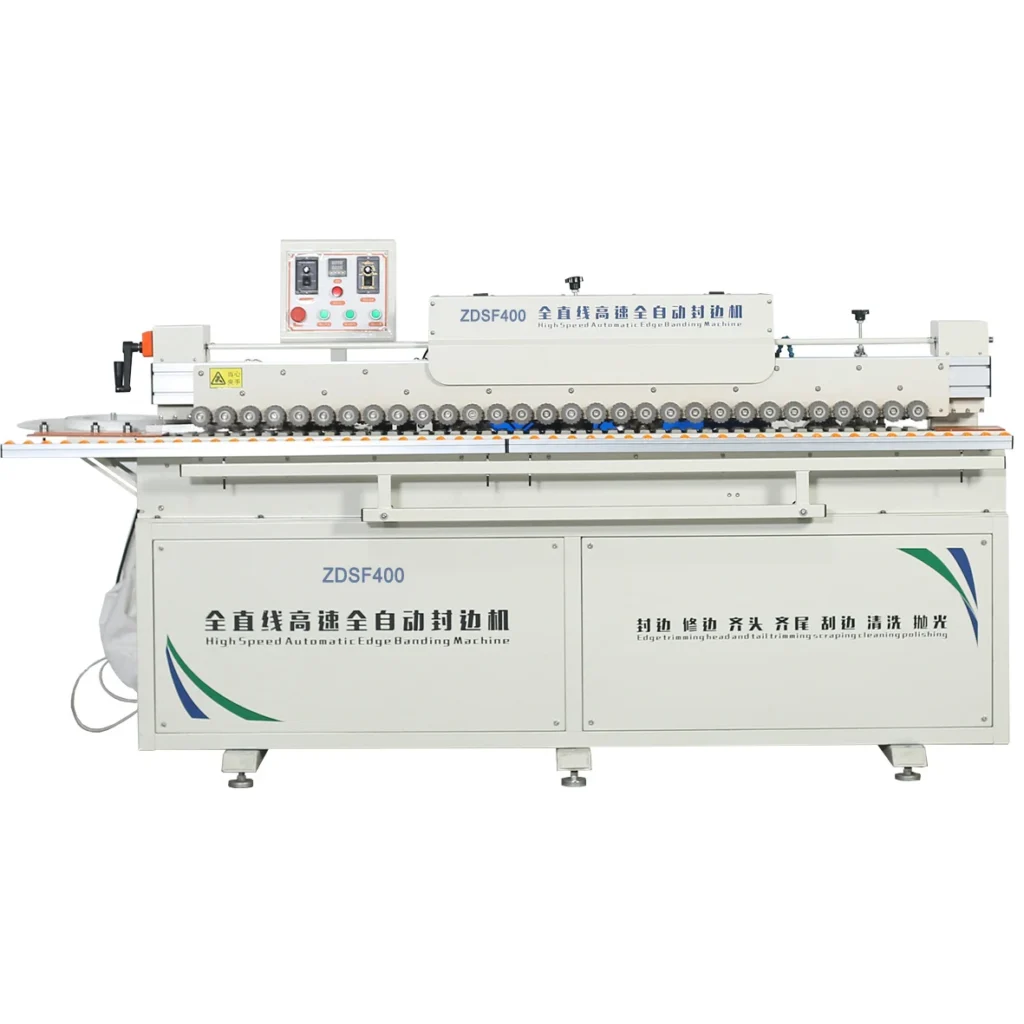
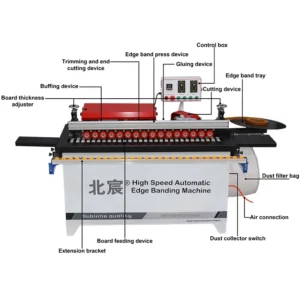
Ready-to-ship configuration — Every ZDSF400 is tested on actual panel stock and verified for your local voltage before dispatch, eliminating the dead-on-arrival risk that plagues small workshop equipment imports.
Technical Specifications
| Parameter |
Value |
| Model |
ZDSF400 |
| Product Type |
Straight Line Automatic Edge Banding Machine |
| Function Sequence |
Gluing, End Cutting, Trimming, Scraping, Polishing, Vacuuming |
| Edge Type |
Straight Line |
| Rated Voltage |
220V |
| Rated Power |
3kW |
| Heating Power |
800W (5–10 min heat-up) |
| Trimming Power |
800W × 2 (24,000 rpm) |
| Polishing Power |
180W × 2 (5,500 rpm) |
| Suction Power |
550W |
| Rated Air Pressure |
0.4–0.6 MPa |
| Feed Speed |
0–14 m/min |
| Conveyor Belt Speed |
0–14 m/min |
| Strip Thickness |
1–3mm |
| Sheet Thickness |
10–55mm |
| Sheet Width |
≥60mm |
| Glue Capacity |
1000ml |
| Overall Dimensions (L×W×H) |
240×70×120 cm |
| Net Weight |
370 kg |
| Assembly State |
Partially assembled with manual and video guidance |
| Warranty |
1 year (factory defect coverage; spare parts replacement) |
Application Suitability
| Application |
Material or Output |
| Small-scale custom cabinet production |
MDF and particleboard panels with PVC straight edge banding |
| Home decoration contractor on-site finishing |
Plywood wardrobe and kitchen cabinet panels with veneer banding |
| Joinery startup transitioning from hand tools |
Solid wood panels up to 55mm thickness with 1–3mm strips |
| Low-volume batch furniture making |
Standard panel stock processed at 0–14 m/min feed rate |
Why the Voltage Question Must Come Before Everything Else
Confirm your workshop mains supply before you confirm the order — not after the crate arrives.
I worked the export desk long enough to see the same avoidable failure repeat itself. A small carpentry shop orders an automatic edge banding machine in stock, pays the deposit, waits weeks for freight — and then the machine sits silent because the workshop only has single-phase 220V outlets while the unit was built for 380V three-phase. The electrician needs to pull new cable, install a dedicated breaker, and sometimes wait for the utility to upgrade the service drop. I have watched that gap stretch into weeks of lost production time [NEED_CITE: voltage and frequency standards by export market].
The ZDSF400 is built around a 220V rated supply and a 3kW total power draw specifically so a small workshop can plug it into an existing circuit without an electrical renovation. But even within 220V markets, frequency matters — 50Hz and 60Hz regions require different motor winding configurations, and getting this wrong means the motor overheats within the first hour of operation.

The Smallest Viable Footprint for a Growing Workshop
When a joinery startup moves from hand-held edge trimmers to a proper automatic edge banding machine in stock, floor space is usually the first constraint. The ZDSF400 occupies a 240×70 cm footprint — long enough to accommodate the six-station sequence from gluing through polishing, but narrow enough to fit against a workshop wall alongside a panel saw and a workbench. At 370 kg net weight, it sits on a standard concrete floor without requiring a reinforced foundation or anchor bolts, which keeps installation to a matter of positioning and leveling.
A Clear Upgrade Path Without Replacing the Line
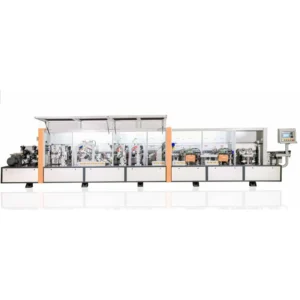
The entry-level investment makes sense only if the machine remains useful as your order volume grows. The 0–14 m/min variable feed speed and 10–55mm sheet thickness range mean this unit handles everything from thin 10mm MDF drawer sides to 55mm solid wood tabletop panels. When production eventually justifies a pre-milling station or a higher-throughput line, the ZDSF400 can shift to a secondary role — handling short runs, sample pieces, or rework — rather than becoming dead capital on the floor [NEED_CITE: CE machinery directive requirements for industrial equipment].
Reading the Numbers That Actually Matter
The 1,000ml glue pot paired with an 800W heating element reaches working temperature in 5–10 minutes, which matters when you are running short batches and cannot afford to let a large glue pot idle for an hour before the first panel. The trimming stations operate at 24,000 rpm with dedicated 800W motors on each side, producing a clean cut on PVC and veneer strips up to 3mm thick — this directly affects whether the finished edge requires additional hand-scraping before it leaves the bench. The 0.4–0.6 MPa air pressure requirement means a standard small workshop compressor handles the pneumatic actuators without needing a dedicated air supply upgrade.
What Happens When You Skip the Compatibility Check
Single machines bought piecemeal without checking the feed height and throughput against existing equipment create bottlenecks that show up only after installation. A panel saw cutting at a pace the edge bander cannot match, or a conveyor feeding at a height that does not align with the infeed table, forces operators into manual lifting and repositioning that negates the automation you just paid for. The control panel language is another overlooked detail — if the operator cannot read the interface, commissioning stalls and settings drift [NEED_CITE: operator interface language requirements for exported machinery].
What the Manufacturer Brings to This Configuration
In-house manufacturing with patented cutting mechanisms means the trimming precision is verified at the factory, not promised on a spec sheet. The four-stage quality control covering incoming material through pre-shipment verification catches tolerance drift before the machine is crated. Voltage, control panel language, and specification adjustments are treated as standard customization rather than special requests. An engineer reviews your workshop layout and production requirements before issuing a formal quotation, so the configuration you receive matches what you actually need. Factory visits are welcomed if you want to see the assembly floor before committing.
Documentation & Verification
- Factory test record on your specified panel thickness and edge strip material before dispatch
- Electrical schematic with voltage and frequency confirmation matched to your local mains supply
- Operation and maintenance manual in the agreed language with illustrated troubleshooting steps
- Spare parts list identifying consumables and their replacement intervals
- CE declaration of conformity and ISO 9001 certificate for import clearance
- Packing photographs showing crating condition before the unit leaves the factory floor
Installation, Commissioning & Support
- Requires a level concrete floor and a dedicated 220V circuit rated for the 3kW total draw
- Compressed air supply at 0.4–0.6 MPa from an existing workshop compressor or a small dedicated unit
- Partially assembled on arrival with video-guided final assembly for the feed table and guard panels
- First-run calibration covers glue temperature, trimming depth, and conveyor speed matching your panel stock
- One-year warranty covering factory defects with replacement spare parts shipped directly from the facility
What to Include With Your Inquiry
Tell us the panel materials you work with most often — MDF, particleboard, plywood, or solid wood — and the typical sheet dimensions that cross your bench. Confirm your workshop voltage and frequency so the motor and control system arrive configured correctly. Let us know if you need the control panel in a specific language for your operators.
Frequently Asked Questions
Q: What is the smallest panel width this machine can process, and how does that affect my cutting plan?
A: The ZDSF400 handles sheet widths from 60mm upward, which covers narrow cabinet side panels and drawer fronts. If your typical workpieces fall below this threshold, you will need to edge-band them while still attached to a wider carrier board and trim them to final size afterward.
Q: Is 220V single-phase sufficient, or do I need to verify the frequency for my region?
A: The 220V rating matches standard single-phase supply in many export markets, but you must confirm whether your local grid operates at 50Hz or 60Hz. The motor winding and control transformer are configured at the factory based on this information, so please state your frequency when placing the order.
Q: How quickly can a stocked unit be dispatched after order confirmation?
A: Ready-stock units are prepared for crating once the voltage and language configuration are confirmed. Dispatch timing depends on the destination port and current shipping schedules, and a specific date is provided at the quotation stage after your requirements are finalized.
Q: Which spare parts ship with the machine, and what should I reorder first?
A: The standard spare parts package includes high-wear items identified in the supplied parts list. Trimming blades, scraper inserts, and polishing wheels are the typical first reorder items depending on your strip material and daily throughput. The factory supplies replacements directly.
Q: Can I add pre-milling or additional functions later without replacing the entire machine?
A: The ZDSF400 is designed as a self-contained six-station unit. Adding pre-milling or additional processing stations typically means upgrading to a different model in the product family rather than retrofitting this frame. Your production volume at that stage usually justifies a dedicated line configuration.