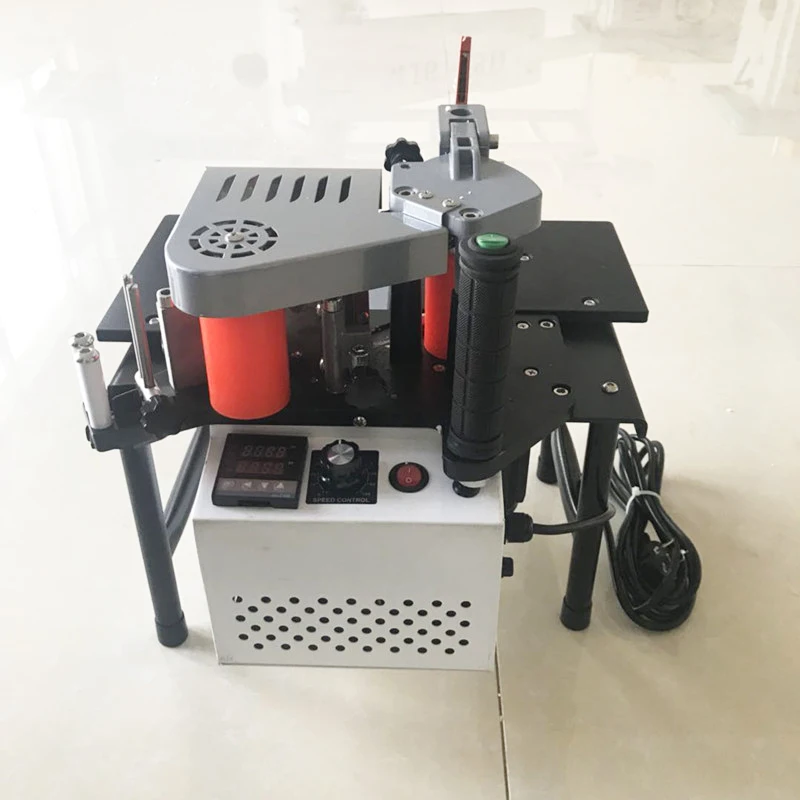
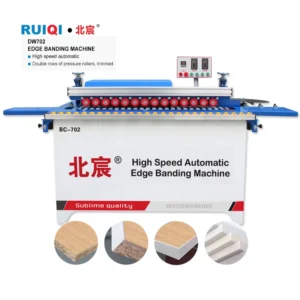
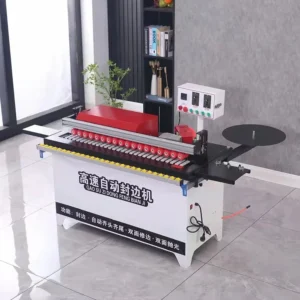
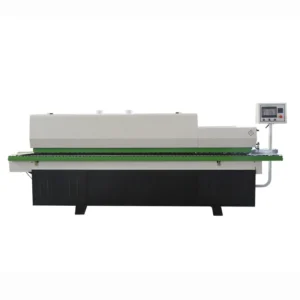
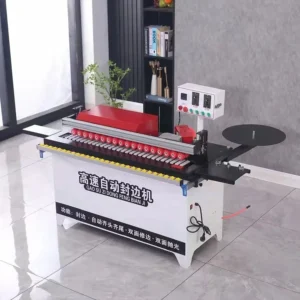
Ready for immediate dispatch — a compact, benchtop edge bander configured with your local voltage and plug type before it leaves the factory floor, eliminating the most common reason small workshop machines sit idle on arrival.
Technical Specifications
| Parameter |
Value |
| Product Type |
Portable Edge Banding Machine |
| Voltage |
220V (configurable from 110V to 440V) |
| Rated Power |
1000W |
| Plate Shape Compatibility |
Curved & Straight plates |
| Edge Thickness Range |
0.3–3mm |
| Board Thickness Range |
7–60mm |
| Gluing Method |
Double-sided gluing |
| Glue Pot Capacity |
800ml |
| Net Weight |
14kg |
| Overall Dimensions (L×W×H) |
440×410×450mm |
| Plug Options |
EU / AU / UK / USA / CN |
| Logo Customization |
Available |
| Control System |
Manual / Semi-automatic |
| Warranty |
1 year (source value — verify against manufacturer catalog) |
| Assembly State |
KD packing with user manual and video teaching (source value — verify against manufacturer catalog) |
Application Suitability
| Application |
Material or Output |
| Small joinery workshop transitioning from hand iron-on banding |
MDF, plywood, and particleboard panels for cabinet doors and shelving |
| Custom furniture maker handling mixed geometries |
Curved cabinet components and straight shelving runs with PVC or veneer edge banding |
| Low-volume production and on-site repair work |
Solid wood panels and rework on previously assembled furniture pieces |
| Startup cabinet shop building initial production capability |
Entry-level batch processing of standard panel sizes with a clear path to full-size automation |
Why the Voltage Question Should Come Before the Price
A portable edge banding machine in stock is only useful if it actually runs when you plug it in. Confirming your workshop's voltage and frequency before placing the order prevents the most frustrating outcome in small equipment procurement: a machine that sits on the bench because the motor burns out on the wrong supply.
I have watched a small workshop owner in Ningjin unbox a machine, wire it up, and immediately trip the breaker because the motor was configured for a different regional standard. The glue pot never reached temperature, and the edge banding lifted within hours. That unit had been quoted and shipped without anyone asking a single electrical question. Since then, I treat voltage confirmation as the first line on every configuration sheet, not an afterthought buried in the shipping documents [NEED_CITE: voltage and frequency standards by export market]. When a buyer receives a portable edge banding machine in stock with the correct plug already fitted, commissioning becomes a matter of filling the glue pot and running a test piece — not sourcing adapters or rewiring a workshop circuit.

Dispatch Timing That Matches Small-Shop Urgency
Small workshops do not have the luxury of planning equipment purchases months ahead. A broken edge banding solution or a new client order typically means the machine is needed now, not in twelve weeks. The portable edge banding machine in stock model addressed here ships as a stocked configuration with standard voltage and plug options pre-selected, meaning dispatch lead time is measured in days rather than production cycles.
This matters most for joinery startups and one-person cabinet shops where every day of manual edge banding is a day of lost margin. The 14kg benchtop format means it arrives by courier or small freight, not container shipment, further compressing the timeline from order to first glued panel.
Curved and Straight Edges on One Machine
Most entry-level edge banders force a choice: a straight-line feed system that cannot handle radius work, or a handheld unit that sacrifices glue consistency on longer runs. The double-sided gluing method on this machine applies adhesive to both the panel edge and the banding strip simultaneously, which is the configuration needed to maintain bond integrity when the workpiece transitions from a straight cabinet side to a curved door profile.
The 0.3–3mm edge thickness range covers standard PVC, melamine, and thin veneer banding materials commonly stocked by small furniture makers. An 800ml glue pot provides enough capacity for sustained runs without constant refilling, which keeps the operator focused on feed control rather than pot management [NEED_CITE: adhesive open time requirements for portable edge banding operations].
What the Spec Sheet Numbers Mean at the Bench
The 7–60mm board thickness range defines the real-world versatility of this machine for a mixed-material workshop. A 7mm minimum means thin MDF backing panels and drawer bottoms can be edged without the workpiece slipping below the guide fence. The 60mm maximum accommodates thick solid wood benchtops and multi-layer laminated shelving — materials that would jam the feed mechanism on smaller benchtop units designed only for standard 18mm particleboard.
Rated power at 1000W is sufficient to hold the glue pot at working temperature continuously while the operator manually feeds the workpiece. Lower-wattage units struggle to recover heat between panels, causing the adhesive to skin over and produce visible glue lines on lighter-coloured banding. The 440×410×450mm footprint means the machine occupies less bench space than a standard sliding table saw offcut, leaving room for trimming and sanding operations on the same work surface. Net weight of 14kg keeps the unit stable during curved-edge feeding, where lateral forces tend to push lighter machines across the bench.
The Hidden Cost of Skipping Configuration Questions
When a portable edge bander arrives without confirmed voltage compatibility, the workshop faces a choice between returning the machine at significant freight cost or hiring an electrician to rewire the motor and control circuit. Neither option is cheap, and both delay production. Beyond the electrical issue, machines configured without knowledge of the actual panel materials being processed often ship with glue temperature settings optimised for one substrate type, producing poor adhesion on everything else.
I once spent an evening on the phone walking a workshop owner through glue temperature adjustments because his semi-automatic unit had been shipped with factory defaults set for PVC on particleboard, while he was running veneer on plywood. The bond failures had already cost him a rework cycle on a kitchen installation. The machine was technically functional — it was simply configured for the wrong job [NEED_CITE: adhesive temperature variance across substrate and banding material combinations]. These problems are entirely avoidable when the configuration conversation happens before the machine is packed.
What Purchasing Through This Channel Secures
Voltage and plug type are confirmed against your workshop's local supply before the machine is released from stock, not guessed from the destination country code. Multiple plug standards — EU, AU, UK, USA, and CN — are available at the point of order, removing the need for adapter improvisation on the bench.
The four-stage quality control process covering incoming material, in-process assembly, finished product inspection, and pre-shipment verification applies to this portable unit with the same rigour used on full-size production line machinery. Pre-shipment test records and packing photographs are provided before dispatch, so you see the machine running before it leaves the factory.
An operation and maintenance manual is supplied in your agreed language, covering glue pot temperature management, feed technique for curved panels, and daily cleaning of the gluing mechanism. Spare parts lists ship with the unit for immediate consumable planning.
Documentation & Verification
- Factory test record showing glue adhesion on your specified panel thickness range before dispatch
- Electrical schematic confirming configured voltage and plug type matched to your workshop supply
- Operation manual in agreed language covering curved and straight edge feed techniques
- Spare parts list included for immediate ordering of glue pot elements and feed components
- Packing photographs provided before shipment for visual condition verification
Installation, Commissioning & Support
- Benchtop placement on a stable surface supporting the 14kg unit weight with clearance for curved panel feed
- 220V dedicated circuit recommended for the 1000W rated power to maintain consistent glue pot temperature
- KD packing requires assembly of feed guide and glue pot housing using supplied manual and video
- First commissioning includes glue temperature calibration against the specific banding material in use
- Daily cleaning of the 800ml glue pot and feed roller to prevent adhesive buildup on mixed-material runs
- Spare glue pot heating elements and feed rollers recommended for initial stock order
Before You Request a Quote
To configure this portable edge bander correctly for your workshop, we need to know the primary panel materials you are working with — MDF, plywood, particleboard, or solid wood — and whether your work includes curved components. Your local voltage and frequency, along with the plug standard in use, should be confirmed at the inquiry stage. If you are transitioning from manual iron-on banding, let us know your current daily panel volume so we can advise whether this unit covers your needs or whether a full-size automatic edge bander is the more appropriate step.
Frequently Asked Questions
Q: How do I confirm the right voltage and plug type for my workshop before ordering?
A: State your local supply voltage and frequency, along with the plug standard currently used on your workshop circuits, when you submit your inquiry. The machine is configurable across 110V to 440V with EU, AU, UK, USA, and CN plug options available at dispatch. We confirm the exact electrical configuration on the quotation before production release.
Q: What panel materials and edge banding types does this portable machine handle?
A: The machine processes MDF, plywood, particleboard, and solid wood panels in the 7–60mm thickness range. Edge banding materials from 0.3mm to 3mm are compatible, covering standard PVC, melamine, and thin veneer strips. Double-sided gluing supports both curved and straight panel geometries.
Q: How fast can I expect dispatch after placing a single-unit order?
A: Stocked configurations with standard voltage and plug options are prepared for dispatch once the pre-shipment test and packing verification are complete. Single-unit orders ship via courier or small freight given the 14kg benchtop format, compressing delivery timelines compared to container-based shipments.
Q: What is the upgrade path when my production volume outgrows this entry-level machine?
A: The product family scales from this portable unit through semi-automatic and full-function pre-milling automatic edge banders within the same manufacturing range. Transitioning to a full-size model does not require changing supplier or relearning a different control interface, keeping your operator training investment intact.
Q: What spare parts and consumables should I stock from day one?
A: The spare parts list supplied with the machine identifies glue pot heating elements, feed rollers, and adhesive-specific cleaning supplies as primary consumables. Stocking these items from the initial order prevents unplanned downtime when components reach their service interval during regular production.