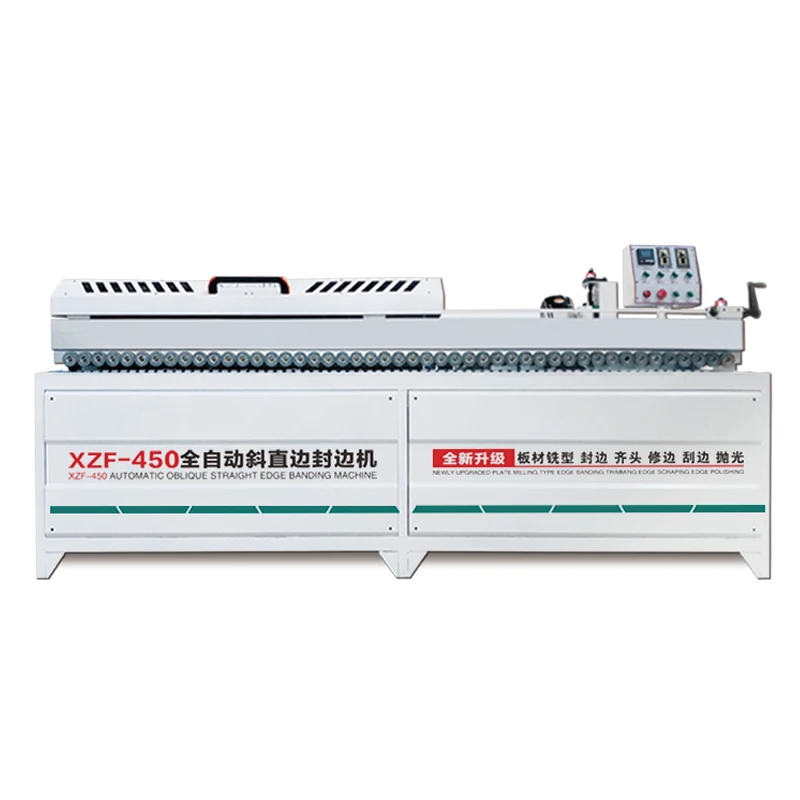
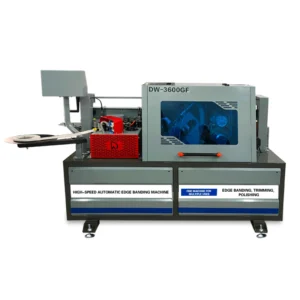
Compact Footprint with Full Automation — the XZF-450 delivers seven integrated edge banding functions within a 300 cm frame, designed for workshops moving from hand banding to consistent machine output.
Technical Specifications
| Parameter |
Value |
| Model |
XZF-450 |
| Product Type |
Automatic Edge Banding Machine |
| Total Power |
9.5 kW |
| Voltage |
380V / 415V (configurable from 110V to 440V) |
| Feed Speed |
0–12 m/min |
| Pre-milling Motor |
4 kW |
| Trimming Power |
2.2 kW × 2 |
| Polishing Power |
0.4 kW × 2 |
| Vacuum Power |
550 W |
| Transmission Power |
180 W |
| Edge Banding Height |
0–50 mm |
| Edge Banding Thickness |
0.3–3 mm |
| Minimum Sheet Length |
30 cm |
| Minimum Sheet Width |
15 cm |
| Glue Pot Capacity |
4000 ml |
| Air Source Pressure |
0.5–0.7 MPa |
| Overall Dimensions (L×W×H) |
300 × 65 × 135 cm |
| Net Weight |
430 kg |
| Control Panel Language |
Chinese and English (customizable to Spanish or other languages) |
| Plug Options |
EU, USA, AU, UK |
| Key Features |
Plate milling, 30/45/60° edge banding, trimming, scraping, polishing, high-power vacuuming |
Application Suitability
| Application |
Material or Output |
| Custom cabinet door edge banding |
MDF and melamine board up to 50 mm thickness |
| Plywood shelving and carcass panels |
Plywood and blockboard with PVC or veneer banding |
| Small-batch furniture production |
Particleboard and polymer door components |
| Angled edge profiles for beveled designs |
30°, 45°, and 60° edge banding on solid wood board |
| Joinery workshop transition from manual work |
Mixed panel formats from 30 cm minimum length upward |
Why Voltage Confirmation Must Happen Before You Commit
An automatic edge banding machine for small workshop use that arrives with the wrong voltage is a 430 kg paperweight sitting on your floor. Confirming local supply specifications is the first step, not an afterthought once the crate shows up.
I have watched small joinery shops lose weeks of production because the machine was quoted and shipped on a default 380V assumption while the workshop ran on a different supply. The transformer workaround costs money, delays commissioning, and introduces a failure point that sits between the wall and the machine every single day. Matching voltage and frequency at the order stage eliminates this entirely [NEED_CITE: voltage and frequency standards by export market].

What Seven Functions Mean for a Startup Workshop
The XZF-450 puts pre-milling, multi-angle edge banding, trimming, scraping, polishing, and dust extraction into a single pass. For a workshop processing MDF or particleboard in low-to-medium volumes, this means every panel leaves the machine finished — no secondary hand trimming, no separate polishing station, no walking parts between benches.
This automatic edge banding machine for small workshop operations handles banding thickness from 0.3 mm to 3 mm, covering both thin PVC for cabinet interiors and thicker veneer for visible furniture faces. The 4000 ml glue pot supports sustained small-batch runs without constant refilling stops.
The Upgrade Path Built Into One Product Family
Starting with the XZF-450 does not lock you into a dead end. When your daily panel count grows beyond what a 0–12 m/min feed speed supports, the next tier within the same product family accepts higher throughput without requiring new operator training or a different spare parts supply chain.
Buying piecemeal single machines from different suppliers often leads to feed height mismatches and incompatible material flow between stations. Sourcing your entry-level automatic edge banding machine for small workshop production from a range that scales means your first investment stays relevant even as volume increases [NEED_CITE: production line throughput matching across woodworking stations].
Reading the Numbers That Actually Matter
The 4 kW pre-milling motor is the specification that separates this machine from basic trim-only banders. Pre-milling removes saw marks and uneven edges from the panel before the glue roller meets the substrate, which is why edge quality on particleboard and MDF depends heavily on this stage. Without adequate pre-milling power, visible glue lines appear on porous substrates no matter how well the trimming and polishing stations perform.
The 0–50 mm edge banding height range covers standard cabinet panels through to thicker shelving and door components. Combined with the 30 cm minimum sheet length, this machine processes the small offcuts and narrow drawer fronts that larger production banders cannot grip reliably.
Feed speed at 0–12 m/min gives operators control over glue penetration on different substrates. Slower feed on solid wood allows more open time for adhesive bonding, while faster feed on melamine board keeps throughput moving during batch runs. The 2.2 kW dual trimming motors handle both straight and angled profiles without bogging down at higher speeds [NEED_CITE: edge trimming motor load variation across substrate types].
The Hidden Cost of Skipping the Panel Test
Every workshop runs a slightly different mix of substrates, and edge banding behavior on MDF does not predict behavior on raw particleboard or plywood. Skipping a sample processing test before ordering means you discover glue line issues, trimming chatter, or scraping residue only after the machine is installed and your first production batch is already late.
I once configured a machine for a cabinet maker without asking whether they ran high-density fiberboard or standard particleboard. The result was visible glue seams on every panel, weeks of adjustments, and a frustrated operator who lost confidence in the equipment before it was properly dialed in. A test run on your actual material removes that entire chapter [NEED_CITE: substrate density variation and adhesive bonding requirements].
Why Procurement Through This Channel Works
Every XZF-450 ships with a factory test record verifying performance on your specified panel thickness and banding material before it leaves the production floor.
Voltage, plug type, and control panel language are confirmed in writing during the order process — not assumed from a default configuration sheet.
The four-stage quality process covers incoming material inspection, in-process checks, finished product verification, and pre-shipment testing, so the machine you receive matches the specification you approved.
An engineer reviews your workshop layout and panel mix before proposing the configuration, ensuring the machine fits your actual production rather than a generic assumption about small workshop needs.
The same product family extends to higher-capacity models, so your initial investment sits on a clear upgrade path without switching suppliers.
Documentation & Verification
- CE declaration of conformity for the XZF-450 automatic edge banding machine
- Factory test record run on your specific panel material and thickness
- Electrical schematic confirming your local voltage and plug configuration
- Operation and maintenance manual in your agreed operator language
- Spare parts list with part numbers for trimming blades, scraper inserts, and glue roller
- Packing photographs showing crate condition before dispatch
Installation, Commissioning & Support
- Requires a dedicated 380V/415V circuit rated for 9.5 kW total draw with proper grounding
- Allow 300 cm length plus operator clearance on the feed side for panel handling
- Compressed air supply at 0.5–0.7 MPa with a dedicated line and moisture separator
- First startup includes glue pot temperature calibration for your specific banding material
- Operator training covers control panel functions in your confirmed language setting
- Trimming blades and scraper inserts ship with the machine as initial spare stock
Before You Request a Quote
Tell us the panel materials you actually cut — MDF, particleboard, plywood, or a mix — along with the thickness range you run most often. Confirm your workshop voltage and frequency so the electrical system is built to match. If your operators need the control panel in a language beyond English, note that in your first message so the interface is configured before the machine ships.
Frequently Asked Questions
Q: Is the XZF-450 the right entry-level size for my current volume, and can I upgrade later?
A: The XZF-450 suits workshops transitioning from manual edge banding to automated output in low-to-medium volumes. Its 0–12 m/min feed speed and 4000 ml glue pot handle sustained small-batch production. When volume grows, the same product family offers higher-capacity models with consistent controls and spare parts, so your operator skills and maintenance routines transfer directly.
Q: How do I confirm voltage and plug type before the machine ships?
A: Voltage is configurable from 110V to 440V, and plug options include EU, USA, AU, and UK standards. We confirm your local supply voltage and frequency in writing during the order process, then configure the electrical system and plug accordingly. The electrical schematic in your documentation package reflects the exact configuration shipped.
Q: Can the control panel be set in my operator's preferred language?
A: The standard panel comes in Chinese and English. Spanish and other languages are available on request and confirmed before production. The operation and maintenance manual is also provided in your agreed language, so commissioning and daily operation do not depend on translation guesswork.
Q: What panel materials and thicknesses does this machine handle well?
A: The XZF-450 processes MDF, melamine board, plywood, blockboard, particleboard, solid wood board, and polymer door panels. Edge banding height covers 0–50 mm, and banding thickness ranges from 0.3 mm to 3 mm. The 4 kW pre-milling motor prepares porous substrates like particleboard for clean adhesive bonding.
Q: What are the minimum workshop space and air supply requirements?
A: The machine footprint is 300 × 65 × 135 cm with a net weight of 430 kg. Allow additional clearance on the feed and exit sides for panel handling. A compressed air source at 0.5–0.7 MPa with adequate volume for the vacuum and pneumatic systems is required, along with a dedicated electrical circuit for the 9.5 kW total power draw.