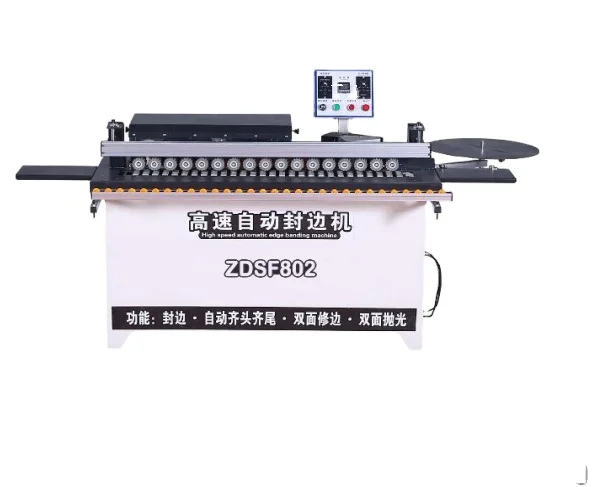
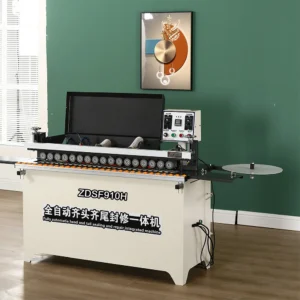
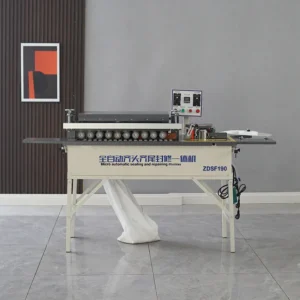
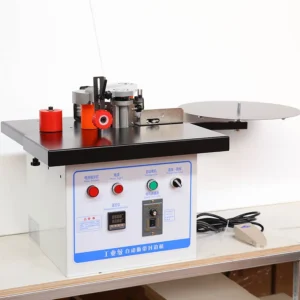
Ready-Stock Dispatch — Every stocked unit is voltage-verified and factory-tested before it leaves the dock, so a small workshop can power up and produce on day one.
Technical Specifications
| Parameter |
Value |
| Product Type |
Portable Automatic Edge Banding Machine |
| Edge Type |
Straight line |
| Rated Voltage |
220V |
| Rated Power |
4 kW |
| Trimming Power |
800 W × 2 |
| Polishing Power |
180 W × 2 |
| Suction Power |
1200 W |
| Heating Power |
1000 W (5–10 min heat-up) |
| Glue Pot Capacity |
4000 ml |
| Panel Thickness Range |
10–50 mm |
| Strip Thickness Range |
0.5–2.5 mm |
| Feed Speed |
0–10 m/min |
| Conveyor Belt Speed |
0–10 m/min |
| Rated Air Pressure |
0.4–0.6 MPa |
| Overall Dimensions (L×W×H) |
130 × 65 × 75 cm |
| Machine Weight |
150 kg |
| Conveyor Belt Material |
Silicone |
| Pressure Beam |
One-piece integrated, double rows of pressure wheels |
| Belt Breaking Method |
Pneumatically controlled |
| Control Panel |
Digital display for glue pot temperature, independent switches |
| Extendable Support |
Fluent strips for large panel stabilization |
Application Suitability
| Application |
Material or Output |
| Small-batch custom cabinet edging |
MDF and particleboard with PVC or veneer banding |
| Joinery startup straight-line runs |
Plywood panels with 0.5–2.5 mm melamine or wood veneer strips |
| Secondary edge banding for quick jobs |
Solid wood panels with pre-glued or hot-melt edge banding |
| On-site workshop installations |
Lightweight, single-phase 220V operation in compact spaces |
Why the Voltage Question Should Come Before the Price
A portable automatic edge banding machine in stock fast delivery means nothing if the motor overheats on a 60 Hz supply.
I once watched an entry-level edge bander sit idle for two weeks in a Gulf workshop because nobody confirmed the local 60 Hz frequency against a motor rated for 50 Hz. The thermal overload tripped every forty minutes, and the operator spent half a day resetting breakers instead of edging panels [NEED_CITE: voltage and frequency standards by export market]. With this unit, the 220V single-phase supply must be matched to your shop's actual grid before it ships — a five-minute check that prevents weeks of downtime.

Stocked Units and Realistic Lead Times
This portable automatic edge banding machine in stock fast delivery is configured for workshops that cannot wait eight weeks for a container. The machine ships with the glue pot calibrated, the trimming motors aligned, and the silicone conveyor belt tensioned from the factory floor. You receive a unit that is ready to run straight-line PVC and veneer banding the moment it is positioned and connected to a 220V supply and an air compressor meeting the 0.4–0.6 MPa requirement.
What Small-Batch Really Means Here
The 0–10 m/min feed speed is deliberately scoped for cabinet shops running tens of panels per shift, not hundreds. Pushing an entry-level bander beyond its design envelope leads to glue starvation on the strip and chatter marks on the trimmed edge. Shops that anticipate sustained high-volume output should evaluate a higher-tier machine with additional trimming stations and a wider feed speed range, rather than overworking a unit built for flexibility over throughput [NEED_CITE: edge bander station configuration and throughput matching].
Glue Pot Capacity and Panel Thickness
The 4000 ml glue pot holds enough hot-melt adhesive for extended runs without stopping to refill, which matters when a single operator is feeding panels and monitoring edge quality simultaneously. The 10–50 mm panel thickness range covers standard 18 mm MDF cabinet sides as well as thicker solid wood shelving, but the trimming cutters and pressure beam geometry are optimized for the straight-line edges these materials present. Attempting to feed curved or contoured workpieces through a straight-line bander will jam the pressure wheels and damage the strip.
The Hidden Cost of Skipping Voltage Verification
When a 220V 50 Hz motor is plugged into a 60 Hz supply, the rotor spins faster but the cooling fan cannot move enough air at the altered load curve. The result is intermittent thermal shutdown that an operator may mistake for a random fault, swapping fuses and wasting hours before calling for support [NEED_CITE: CE machinery directive requirements for industrial equipment]. Confirming your local voltage and frequency at the order stage eliminates this entirely, and every stocked unit can be verified against your grid specification before dispatch.
Why Procure Through This Channel
Stocked inventory means you skip the production queue and the multi-week fabrication lead that custom-ordered machines carry. The 130 × 65 × 75 cm footprint and 150 kg weight allow two people to position the machine with a pallet jack — no overhead crane or reinforced floor required. The built-in 1200W dust extraction means you do not need to duct a separate collector before the first panel runs. Voltage confirmation and operation manual language are locked in at order, so the operator reads instructions they can actually follow.
Documentation & Verification
- Factory test record on your specified panel thickness and strip material before dispatch
- Electrical schematic confirming 220V supply and dedicated circuit requirements
- Operation and maintenance manual in your confirmed language
- Spare parts list covering trimming blades, polishing wheels, and silicone belt sections
- Packing photographs showing crate condition and accessory placement prior to shipment
Installation, Commissioning & Support
- Position on a level floor within reach of a dedicated 220V circuit rated for the 4 kW total draw
- Connect shop air supply to meet 0.4–0.6 MPa for pneumatic belt breaking and pressure beam actuation
- Machine arrives fully assembled; operator mounts the extendable fluent strips for large panel support
- First heat-up cycle requires 5–10 minutes to bring the 4000 ml glue pot to working temperature
- Digital display lets the operator set and monitor glue temperature independently of the feed motor switches
How to Start Your Inquiry
Share your primary panel material, the edge strip type and thickness you run most often, and your local voltage and frequency so the correct configuration is confirmed before dispatch. If you are replacing a manual edge banding process, note the daily panel count so the feed speed range can be validated against your output target.
Frequently Asked Questions
Q: Is this machine ready to ship, and what is the dispatch lead time?
A: Stocked units are available for prompt dispatch once voltage compatibility, manual language, and shipping details are confirmed. Unlike made-to-order machines that enter the production queue, this portable automatic edge banding machine in stock fast delivery is pre-assembled and tested on the factory floor, reducing the wait between order placement and shipment.
Q: What voltage options are available for different markets?
A: The standard configuration runs on 220V single-phase supply. If your workshop operates on a different voltage or frequency — such as 110V/60Hz in parts of the Americas or 380V three-phase in some industrial zones — confirm this at the inquiry stage so the motor and control components can be matched before the unit leaves the warehouse.
Q: What panel materials and edge banding types does this model handle?
A: This machine processes MDF, particleboard, plywood, and solid wood panels from 10 to 50 mm thick, applying straight-line PVC or veneer edge banding between 0.5 and 2.5 mm. It is not configured for curved contours or post-formed edges, which require a different machine class entirely.
Q: Does the machine arrive fully assembled or require on-site setup?
A: The unit ships fully assembled with the pressure beam, trimming motors, and conveyor belt installed and aligned. On-site work is limited to unpacking, leveling on the workshop floor, attaching the extendable fluent strips, connecting power and compressed air, and running the initial glue heat-up cycle before the first panel.
Q: How do I scale up to a higher-throughput edge bander as my volume grows?
A: When daily output outpaces the 0–10 m/min feed speed, the logical step is a multi-station automatic edge bander with pre-milling, additional trimming heads, and a wider feed range. Staying within the same product family simplifies operator retraining and spare parts sourcing, since control logic and consumable formats carry over between models.