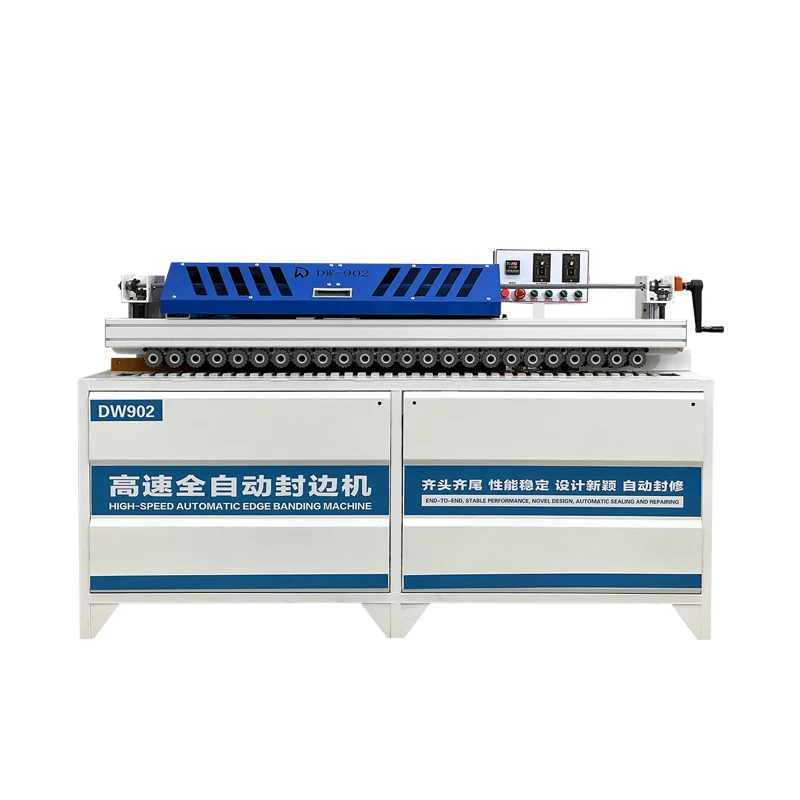
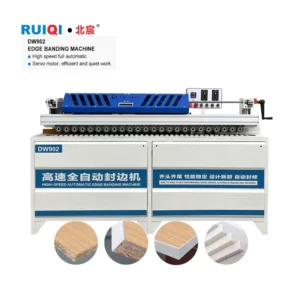
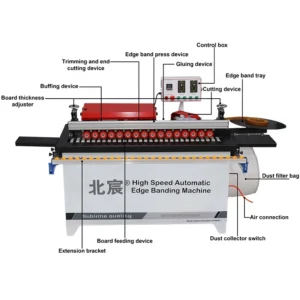
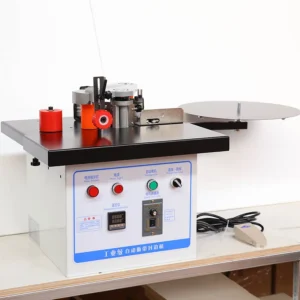
Compact Configuration, Fast Delivery — a 4000W entry-level edge bander assembled and ready for dispatch, cutting typical multi-week lead times for small workshops moving to automated production.
Technical Specifications
| Parameter |
Value |
| Model |
DW902 |
| Product Type |
Automatic Edge Banding Machine |
| Total Power |
4000W |
| Voltage |
220V / 380V / customizable to local frequency |
| Edge Banding Height |
50 mm |
| Edge Banding Thickness |
0.3 – 3 mm |
| Minimum Sheet Length |
250 mm |
| Minimum Sheet Width |
100 mm |
| Edge Power |
140W |
| Transmission Power |
140W |
| Trimming Power and Speed |
800W × 2 / 24000 r/min |
| Polishing Power |
380W × 2 |
| Air Source Pressure |
0.5 – 0.8 MPa |
| Glue Pot Capacity |
4000 ml |
| Vacuum Power |
550W |
| Overall Dimensions (L×W×H) |
1750 × 870 × 1120 mm |
| Net Weight |
240 kg |
| Language Options |
Chinese and English standard; Spanish and others customizable |
| Plug Options |
EU, USA, AU, UK |
| Assembly State |
Fully assembled |
Application Suitability
| Application |
Material or Output |
| Straight edge banding for cabinet panels |
MDF, particleboard, plywood |
| 45-degree bevel edge banding for decorative furniture |
Solid wood board, ecological board, blockboard |
| Small-batch custom cabinet door production |
PVC and veneer edge banding strips, 0.3–3 mm |
| Home decoration panel finishing |
Polymer sheets, MDF, plywood |
| Joinery workshop transition from hand banding |
Particleboard and MDF up to 50 mm panel thickness |
Why the Voltage Question Should Come Before the Price on an Automatic Edge Banding Machine in Stock
Confirm your local voltage and frequency before you sign anything, or the machine sits idle on arrival.
I had a customer last year — a custom furniture shop — who received a 380V edge bander at a facility wired for 220V single-phase. The machine sat on the floor for nearly three weeks while an electrician sorted out the transformer and dedicated circuit. That kind of delay doesn't just cost idle time; it pushes back delivery to the workshop's own clients and damages trust. [NEED_CITE: voltage and frequency standards by export market]
When you're ordering an Automatic Edge Banding Machine in stock, the unit might already be built for a default configuration that doesn't match your grid. The DW902 supports 220V, 380V, and custom frequency setups, but only if we confirm it before production or allocation.

Ready Stock Means Verified Configuration, Not Just a Crate by the Door
The advantage of sourcing an Automatic Edge Banding Machine in stock is speed, but speed only matters if the configuration is right. This DW902 unit ships fully assembled — no foundation bolts to torque on-site, no wiring harnesses to connect in the field. The 4000W total power draw keeps it within single-circuit capacity for most small workshop electrical panels, so you won't need a separate sub-panel installed before commissioning.
We confirm plug format (EU, USA, AU, UK) and control panel language before the crate is sealed. A machine arriving with an unreadable HMI is just an expensive workbench until someone translates it.
What Bevel-Plus-Straight in a Single Pass Actually Saves
The DW902 handles both 45-degree bevel and straight edge banding without a tooling changeover, using four groups of oblique pressure wheels to press the banding strip against angled panel edges. For a small workshop producing custom cabinet fronts and decorative shelving, this eliminates the need for a dedicated bevel machine or the inconsistency of hand-routing edges before banding. [NEED_CITE: typical edge banding defect rates on beveled panel edges in small-scale furniture production]
The 4000 ml glue pot with double hot air design maintains stable adhesive temperature across the full feed path, which matters when you're switching between PVC banding for utility cabinets and thin veneer for visible furniture faces in the same afternoon run.
How the Trimming and Polishing Stations Affect Final Assembly
The dual trimming motors run at 24000 r/min, which translates to a clean shear on PVC and wood veneer banding without tear-out at the panel entry and exit points. When trimming leaves even a slight lip or chatter mark, the downstream assembly — particularly dowel joints and concealed hinge mounting — develops visible gaps. For workshops producing cabinet boxes that ship flat-pack, that gap becomes the customer's problem, not yours.
The 0.3–3 mm banding thickness range covers most standard PVC and veneer strips used in furniture production. The scraping station removes the residual adhesive haze that polishing alone cannot address, leaving an edge that can go straight to packaging without secondary hand-finishing. [NEED_CITE: woodworking edge finish standards for furniture-grade panel products]
The Cost of Ordering a Machine That Doesn't Match Your Panel Range
Buyers sometimes select an edge bander based on its maximum panel thickness without checking the minimum sheet dimensions. The DW902 requires panels to be at least 250 mm long and 100 mm wide — small enough for most cabinet components, but too large for narrow drawer-side strips or thin shelf edging. Workshops that produce a high volume of narrow workpieces need to know this boundary before ordering.
Mismatched feed height and throughput between a new edge bander and existing saws or boring machines creates bottlenecks that no specification sheet will warn you about. [NEED_CITE: production line balancing principles in small-scale woodworking]
Why Procurement from This Source Differs
Voltage and plug confirmation happens before allocation, not after the invoice is paid. Every DW902 leaves with a factory test record run on panel material within your specified thickness range, and we send packing photographs before the crate is sealed.
The machine arrives fully assembled, which matters for workshops without overhead cranes — the 240 kg unit can be positioned with a standard pallet jack. Control panel language is matched to your operator before shipment, so commissioning begins on day one rather than after a translation exercise.
Four-stage quality control covers incoming material inspection, in-process assembly checks, finished product verification, and pre-shipment functional testing. This isn't a brochure claim; it's the documentation trail that accompanies your machine.
Documentation & Verification
- Factory test record on your specified panel thickness and banding material before dispatch
- Electrical schematic confirming the voltage and plug format you approved at order stage
- Operation and maintenance manual in your chosen language, included in the crate
- Packing photographs sent for your review before the wooden crate is sealed
- Spare parts list covering consumable trimmer blades and polishing wheels
Installation, Commissioning & Support
- Requires a level concrete floor with clear access for a pallet jack given the 240 kg net weight
- Dedicated 4000W circuit with correct voltage confirmed before machine power-on
- Ships fully assembled — no on-site mechanical assembly or belt tensioning needed
- First-run glue temperature and feed speed calibration included in commissioning guidance
- Trimmer blade and polishing wheel replacement intervals documented in the included manual
- Air supply connection rated 0.5–0.8 MPa with standard quick-connect fitting
Before You Request a Quote
Tell us the panel materials you run most often — MDF, particleboard, plywood, or solid wood — and the edge banding type and thickness you typically use. Confirm your local voltage and frequency so we allocate the correct configuration from stock. If your workshop operates in a language other than Chinese or English, specify it upfront so the control panel and manual are ready at delivery.
Frequently Asked Questions
Q: What voltage and plug format will be confirmed before I order?
A: We confirm your local voltage, frequency, and plug type before allocating the DW902 from stock. The machine supports 220V, 380V, and custom configurations with EU, USA, AU, or UK plug formats. This is verified at the quotation stage so the machine you receive matches your workshop's electrical infrastructure without modification.
Q: Can I get the control panel and manual in my local language?
A: Chinese and English are standard on the DW902 control interface and documentation. Spanish and other languages are available as customization options, confirmed at order placement. The goal is to have your operators reading the HMI and maintenance manual from day one, without relying on third-party translation after delivery.
Q: What panel materials and edge banding thicknesses does the DW902 handle?
A: The machine processes MDF, particleboard, plywood, solid wood board, ecological board, blockboard, and polymer sheets. It applies both 45-degree bevel and straight edge banding with strip thicknesses from 0.3 to 3 mm, covering standard PVC and veneer materials used in furniture and cabinet production.
Q: How fast can I expect delivery from ready stock?
A: Stock units are dispatched after pre-shipment testing and packaging verification, which typically requires a short preparation period for voltage confirmation, language configuration, and factory test record generation. Exact dispatch timing depends on current stock levels and the customization scope confirmed at order.
Q: What is the minimum order quantity?
A: Single-unit orders are accepted. The DW902 is positioned as an entry-level machine for small workshops and startups, so there is no requirement to purchase multiple units or commit to a production-volume order. One machine ships as a complete, fully assembled, self-contained edge banding solution.