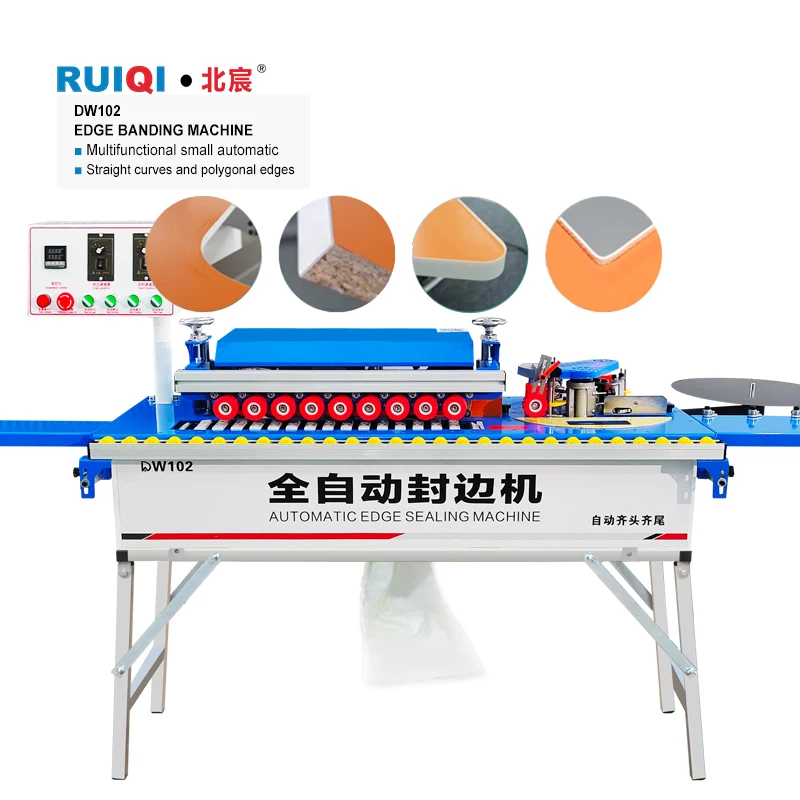
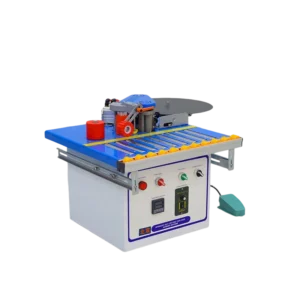
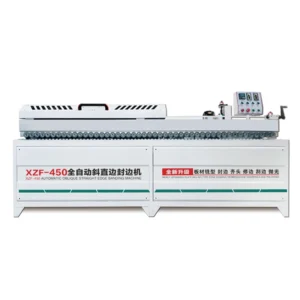
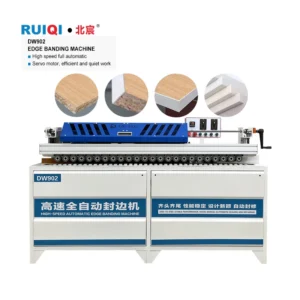
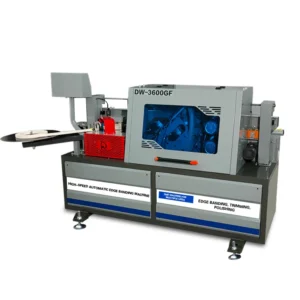
Voltage and language confirmed before dispatch — each DW102 benchtop edge bander ships with an electrical schematic matching your workshop supply and a control panel in the operator's reading language.
Technical Specifications
| Parameter |
Value |
| Model |
DW102 |
| Product Type |
Automatic Edge Banding Machine |
| Total Power |
3800W |
| Voltage |
220V / 380V / customization |
| Edge Banding Height |
0–50 mm |
| Edge Banding Thickness |
0.3–3 mm |
| Minimum Sheet Length |
25 cm |
| Minimum Sheet Width |
5 cm |
| Glue Pot Capacity |
1000 ml |
| Air Source Pressure |
0.5–0.8 MPa |
| Trimming Power |
650W × 2 |
| Polishing Power |
180W × 2 |
| Vacuum Power |
1200W |
| Transmission Power |
60W |
| Edge Power |
20W |
| Product Dimensions (L×W×H) |
128 × 47 × 69 cm |
| Net Weight |
75 kg |
| Assembly State |
Benchtop / compact standalone |
| Standard Features |
Curved and straight edge banding, edge trimming, polishing, automatic head and tail cutting, integrated vacuum |
| Language Options |
Chinese, English; custom language available |
| Plug Options |
EU, USA, AU, UK |
Application Suitability
| Application |
Material or Output |
| Custom cabinet door edge finishing |
MDF and particleboard with PVC or veneer banding |
| Small-batch plywood shelving |
Plywood panels with straight and curved contours |
| Joinery startup production |
Blockboard and solid wood panels up to 50 mm edge height |
| Polymer door component trimming |
Polymer substrates with 0.3–3 mm edge thickness |
| Curved furniture component banding |
Shaped MDF and plywood panels requiring combined curved and straight edge work |
Why the Voltage Question Should Come Before the Price
A compact edge banding machine in stock means nothing if it cannot run on your workshop supply the day it arrives.
I once sent a unit to a Middle East cabinet shop where the operator could not read the English control panel, and the local three-phase supply did not match the machine wiring. Two days of commissioning lost before we even fed the first panel. That shaped how every DW102 order now begins: voltage, frequency, plug type, and panel language confirmed in writing before production slots are assigned [NEED_CITE: voltage and frequency standards by export market]. A benchtop machine is the smallest investment in a workshop, which makes a preventable electrical mismatch the most frustrating failure mode.

Footprint That Fits a Single Bench
The DW102 sits on a standard workbench at 128 × 47 × 69 cm and 75 kg. No dedicated floor zone, no anchor bolts, no separate dust-extraction ductwork to route before the first run. For a joinery workshop moving from hand tape-and-iron methods to repeatable machine output, the compact edge banding machine in stock arrives as a single crate that one person can position. The 1200W integrated vacuum handles panel hold-down and chip extraction at the same station, so the machine operates independently of the main shop extraction system.
One Machine for Both Curved and Straight Edges
Small workshops rarely have the floor space or budget for separate curved-edge and straight-edge stations. The DW102 handles both geometries on the same feed path, with automatic head and tail cutting that trims the banding flush without a secondary pass. When a cabinet maker receives a mixed batch of rectangular carcase panels and radius-cornered door fronts, both run through without reconfiguration. This eliminates the bottleneck that typically appears when a shop buys a straight-only bander and then subcontracts curved components [NEED_CITE: typical edge banding workflow in small furniture workshops].
Reading the Spec Sheet Against Your Panel Range
The 0–50 mm edge height and 0.3–3 mm banding thickness define what this machine will physically accept. MDF carcase panels at 18 mm thickness with 0.4 mm PVC banding sit comfortably within range; thicker solid-wood lipping at 3 mm pushes the upper limit and requires slower feed speeds for clean trimming. The dual 650W trimming motors provide sufficient torque for both ends of that thickness range, while the 180W × 2 polishing wheels finish the edge without burning softer PVC materials. Glue pot capacity at 1000 ml supports a full morning run on standard panel volumes before replenishment. For workshops processing primarily particleboard with thin melamine banding, the lower end of the thickness range is where most daily work will sit, and the trimming power available exceeds what that substrate demands [NEED_CITE: edge banding thickness selection by substrate type].
What Happens When the Specification Conversation Gets Skipped
A machine arrives wired for 380V three-phase into a workshop running 220V single-phase. The motor hums, the transmission stalls, and the trimming motors never reach operating speed. The buyer assumes a manufacturing defect; the actual cause is a missing line on the order confirmation. Similarly, an operation manual written in a language the operator does not read means the glue pot temperature and feed speed settings are guessed rather than set, producing inconsistent trim quality that gets blamed on the machine. These failures are not warranty claims — they are preventable configuration gaps [NEED_CITE: common causes of edge bander commissioning delays].
Why Procurement Here Reduces Configuration Risk
Voltage and plug type are confirmed per order, not assumed from a default build — the DW102 ships with EU, USA, AU, or UK plugs matched to the destination workshop. Control panel language is set before dispatch, so the operator reads instructions in English or a custom language on day one. The benchtop form factor means a single-unit order ships as one crate with no partial-load consolidation delays. Every unit passes a four-stage quality check including pre-shipment verification, so the test record reflects the actual machine in the crate. Engineer-led configuration recommendation arrives within 24 hours of inquiry, covering voltage, panel range, and production volume before the quotation is issued.
Documentation & Verification
- Electrical schematic confirming 220V or 380V wiring and plug type for your workshop supply
- Operation manual in agreed language covering glue pot settings and feed speed adjustment
- Pre-shipment test record on panel thickness within your specified 0.3–3 mm banding range
- CE declaration of conformity for the DW102 automatic edge banding machine
- Spare parts list identifying consumable trimming blades and polishing wheels
Installation, Commissioning & Support
- Benchtop placement requires a stable surface rated for 75 kg plus panel feed load
- Dedicated circuit matching confirmed 220V or 380V supply before first power-on
- Arrives fully assembled; position, connect air source at 0.5–0.8 MPa, and power up
- First-run glue pot temperature and feed speed calibration included in manual
- Trimming blade and polishing wheel replacement intervals documented per operating hours
What to Include With Your Inquiry
Share your primary panel material, typical thickness range, and whether you process curved edges alongside straight runs. Confirm the workshop voltage and frequency at the installation point, along with the plug type required. Note the operator's reading language so the control panel and manual are configured accordingly.
Frequently Asked Questions
Q: What voltage and plug do I need to confirm before you dispatch the DW102?
A: Provide your workshop supply voltage (220V or 380V), frequency (50Hz or 60Hz), and plug type (EU, USA, AU, or UK). We confirm these in writing before the machine leaves the factory, and the electrical schematic shipped with the unit reflects the exact configuration built for your installation point.
Q: Can I order just one unit, and what is the dispatch lead time from stock?
A: Single-unit orders are standard for the DW102. Stocked units dispatch within a typical multi-week lead time after voltage, plug, and language confirmation. Shipping options are quoted at inquiry based on destination, and the machine ships as one benchtop crate.
Q: How do I handle both curved and straight edges on the same machine?
A: The DW102 processes curved and straight edges on the same feed path without tooling changes. Automatic head and tail cutting trims banding flush on both geometries. Feed both panel types in sequence during a single production run without stopping to reconfigure.
Q: What minimum panel size and edge thickness does the DW102 accept?
A: Minimum sheet dimensions are 25 cm length and 5 cm width. Edge banding thickness ranges from 0.3 mm to 3 mm, and edge height from 0 to 50 mm. These limits cover standard MDF, plywood, and particleboard panels used in cabinet and furniture production.
Q: If I need an operation manual in a language other than English, how is that arranged?
A: Specify the operator's reading language at inquiry. The control panel text and operation manual are configured before dispatch in Chinese, English, or a custom language. This ensures the operator can set glue pot temperature and feed speed correctly on the first day.