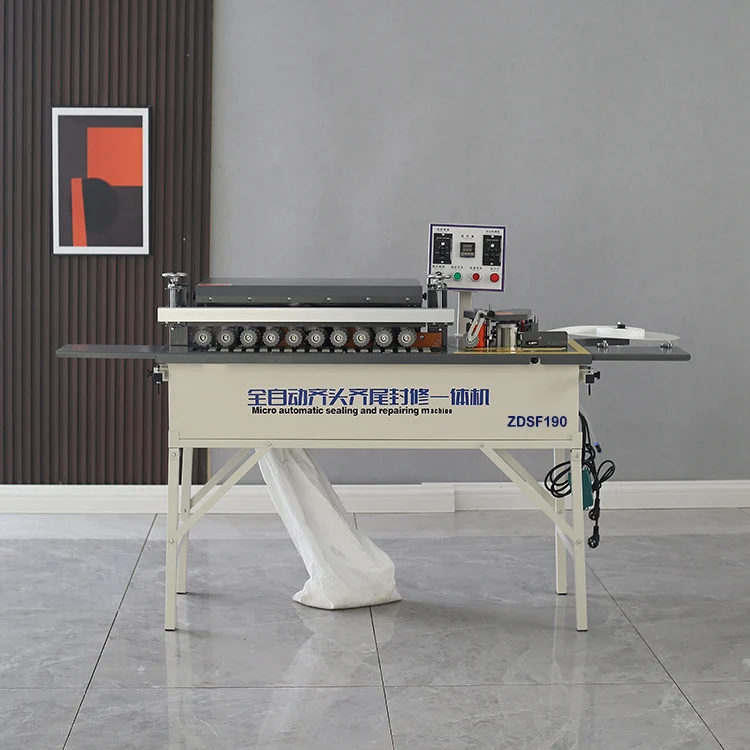
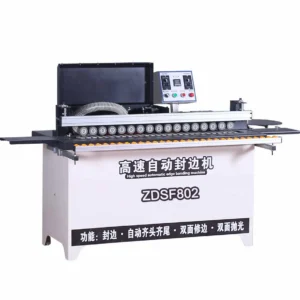
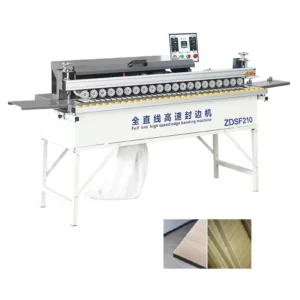
Voltage Customization — ZDSF190 shipped at 220V single-phase, verified against your local supply before dispatch to prevent commissioning stalls.
Technical Specifications
| Parameter |
Value |
| Model |
ZDSF190 |
| Product Type |
Small Automatic Edge Banding Machine |
| Function Stations |
Automatic plate feeding, Gluing, End cutting, Trimming, Vacuuming, Polishing |
| Edge Profile |
Straight and curved |
| Voltage |
220V |
| Rated Power |
4 kW |
| Heating Power |
800 W |
| Polishing Power |
180 W × 2 |
| Trimming Power |
800 W × 2 |
| Suction Power |
1200 W |
| Belt Power |
25 W |
| Transmission Power |
120 W |
| Working Speed |
0–7 m/min |
| Panel Thickness Range |
10–50 mm |
| Strip Thickness |
0.5–2.5 mm |
| Glue Capacity |
1000 ml |
| Rated Air Pressure |
0.6–0.8 MPa |
| Dust Collection |
Air-tight vacuum collecting, 99% effect |
| Trimming Tool |
Imported brand 4-blade alloy arc knife |
| Overall Dimensions |
1900 × 560 × 1300 mm |
| Weight |
105 kg |
Application Suitability
| Application |
Material or Output |
| Cabinet door edge finishing |
MDF and particleboard panels with PVC or melamine edge strips |
| Custom furniture small-batch production |
Plywood and blockboard with veneer or ABS banding |
| Curved panel edge banding |
Solid wood and shaped MDF components requiring arc trimming |
| Joinery workshop first-machine upgrade |
Mixed panel substrates transitioning from manual hand-trimming |
Why the Voltage Question Must Come Before the Price
A 220V single-phase Small Automatic Edge Banding Machine in stock plugs into a standard workshop outlet — no electrician, no panel upgrade, no waiting.
I spent years commissioning machines across Latin America, and the pattern is always the same. A small cabinet shop orders an entry-level bander, it arrives, and the plug does not match the wall socket. The machine sits idle while an electrician installs a dedicated 380V three-phase line that the shop never needed in the first place. Two or three days of lost production, plus the cost of the electrical work, wipes out whatever savings the buyer thought they were getting. [NEED_CITE: voltage and frequency standards by export market]
For a startup workshop running a handful of cabinets per day, single-phase 220V is not a compromise — it is the correct specification. The ZDSF190 is wired for exactly that environment, drawing 4 kW total across all stations. You unbox it, connect your existing compressor for the 0.6–0.8 MPa air supply, and the machine runs.

Straight and Curved Edges on One Compact Frame
Most workshops at this volume cannot justify separate machines for straight and curved edge work. The ZDSF190 handles both profiles in a single pass through the same station sequence: gluing, end cutting, trimming, vacuuming, and polishing. The imported 4-blade alloy arc knife trims curved edges cleanly without the chatter marks that single-blade cutters leave on radiused corners. For a small furniture maker producing both flat cabinet sides and shaped drawer fronts, this means one Small Automatic Edge Banding Machine in stock covers the entire daily output without re-fixturing.
Dust Extraction That Actually Fits a Small Room
Industrial edge banders assume the shop has a central dust extraction system with large-diameter ducting. Most small workshops do not. The ZDSF190 carries its own 1200 W suction unit with an air-tight vacuum collection path rated at a high capture rate. The trimming and polishing stations feed directly into that enclosed system, so fine PVC and MDF dust stays out of the air rather than settling on finished panels nearby. In a room where the bander sits three meters from the assembly bench, keeping particulate contained matters for both surface quality and operator comfort. [NEED_CITE: workshop air quality standards for woodworking environments]
Reading the Numbers That Matter at This Scale
The 10–50 mm panel thickness range covers everything from thin MDF shelf stock to solid wood countertop slabs a small joinery shop typically encounters. Working speed is adjustable from 0 to 7 m/min, which lets the operator slow the feed for curved sections where the strip needs time to conform to the radius, then speed up for long straight runs. The 1000 ml glue pot is sized for intermittent batch work — large enough to run a full morning without refilling, small enough that glue does not degrade from sitting hot all day. Polishing runs on dual 180 W motors, giving each side independent buffing pressure so the finished edge comes off the machine ready for assembly without a secondary wipe-down.
What Happens When a Small Shop Buys Too Much Machine
A common mistake at the entry level is purchasing a full-production bander rated for volumes the shop will not reach for years. The consequences are practical, not theoretical. A larger machine demands three-phase power, a dedicated compressor with higher CFM output, and a floor footprint that crowds out the table saw and assembly tables. The operator faces a control panel built for a factory line supervisor, not a two-person shop. When the first fault appears, the shop discovers that the machine's complexity exceeds its own ability to troubleshoot, and production halts until a technician arrives. [NEED_CITE: common causes of downtime in small woodworking operations]
What Makes This Procurement Channel Different
Voltage confirmation happens before production, not after — the electrical schematic is matched to your local supply standard and documented in the paperwork package. The operation manual is provided in the language your operator reads, so commissioning day does not turn into a translation exercise. I have watched entire first weeks dissolve because the control panel labels were in a language the shop floor did not speak. The four-stage QC process covers incoming materials, in-process assembly, finished product testing, and pre-shipment verification, so the machine you receive has been run on actual panel stock before crating. OEM and private-label branding is available if you are a distributor placing this Small Automatic Edge Banding Machine in stock into your regional catalog.
Documentation & Verification
- Electrical schematic confirming 220V single-phase wiring matched to your local frequency
- Factory test record run on your specified panel thickness and strip material
- Operation and maintenance manual written in your agreed operator language
- Spare parts list identifying wear items and reorder part numbers from day one
- Pre-shipment photographs documenting machine condition before crating
- CE declaration of conformity for import clearance in regulated markets
Installation, Commissioning & Support
- Requires a flat floor section roughly 2 × 0.6 m with standard workshop clearance around the 1900 × 560 × 1300 mm frame
- Connects to existing 220V single-phase outlet on a dedicated 20A circuit to handle the 4 kW rated draw
- Arrives as a single 105 kg unit — moveable by two people and a pallet jack, no rigging crew required
- Air supply connection requires a compressor delivering 0.6–0.8 MPa at the machine's inlet regulator
- First-run calibration covers feed speed, glue temperature, and trimming knife alignment on your actual panel stock
- Daily maintenance limited to glue pot cleaning, vacuum filter check, and polishing wheel inspection
Before You Request a Quote
Send us your typical panel materials and thicknesses, the edge strip types you run most often, and your local voltage and frequency so we confirm compatibility before anything else. If your operators speak a specific language, tell us now so the manual and control panel labels match. We also want to know what upstream and downstream equipment the ZDSF190 will sit beside — feed height and workflow direction matter even at this scale.
Frequently Asked Questions
Q: What panel and strip thicknesses does the ZDSF190 handle?
A: Panel thickness runs from 10 to 50 mm, covering MDF shelf stock through solid wood countertop slabs. Edge strip thickness is 0.5 to 2.5 mm, which includes PVC, melamine, veneer, and ABS banding materials commonly used in custom cabinet and furniture production at the workshop scale.
Q: Can this 220V model run on my existing single-phase supply?
A: Yes. The ZDSF190 is wired for 220V single-phase and draws 4 kW total across all stations. You need a dedicated circuit with adequate amperage. We confirm your local voltage and frequency before production and provide an electrical schematic so your electrician can verify the connection without guesswork.
Q: How do I know when to move from this entry-level bander to a larger model?
A: Watch your daily run length and whether operators are queuing panels. When a single shift regularly exceeds the 0–7 m/min working speed capacity and you need continuous feed rather than batch loading, that is the signal to evaluate a full-function model with pre-milling and higher feed rates.
Q: What are the space and utility requirements for installation?
A: The machine footprint is 1900 × 560 mm with a height of 1300 mm, and it weighs 105 kg. You need a standard compressor delivering 0.6–0.8 MPa and the integrated 1200 W vacuum handles dust collection internally, so no external extraction ducting is required in a small workshop.
Q: Is the control panel available in my local language?
A: Control panel labels and the full operation manual are produced in your agreed language before dispatch. We confirm this during the quotation stage so your operators can read all instructions and settings on commissioning day without translation delays.