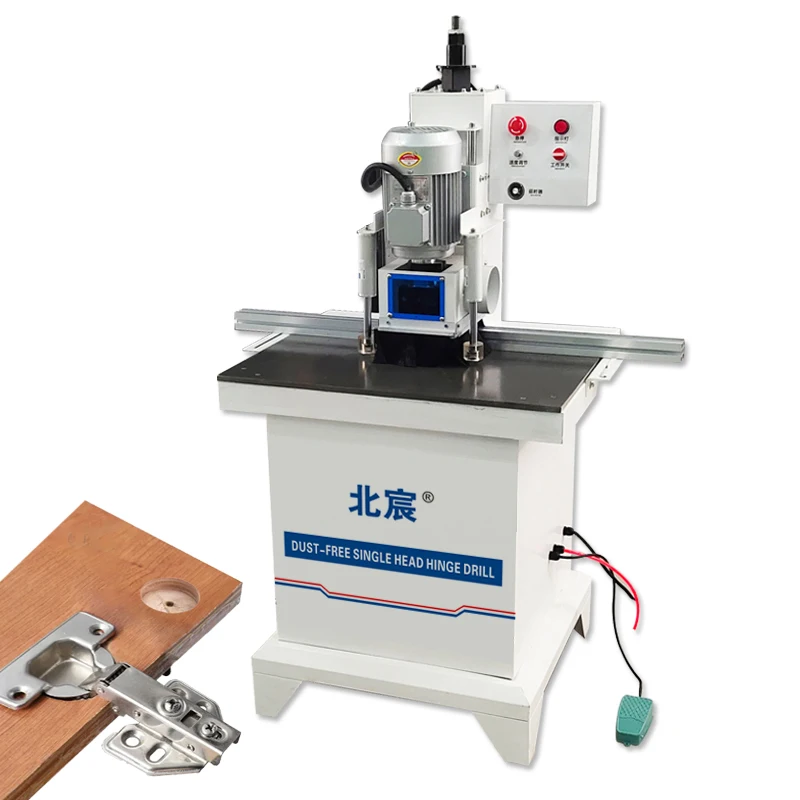
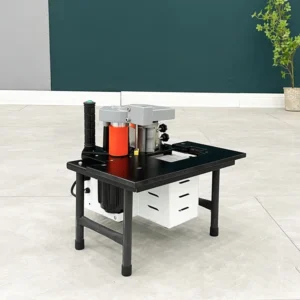
Compact footprint, honest capacity — Sized for joinery startups drilling their first cabinet doors, this single-row hinge boring machine ships ready to run from stock without overpromising throughput.
Technical Specifications
| Parameter |
Value |
| Model |
JL-1 |
| Product Type |
Single-Row Wood Hinge Boring Machine |
| Rated Power |
1.5 kW |
| Voltage & Frequency |
380V/415V three-phase four-wire (configurable from 110V to 440V) |
| Control System |
Foot switch control |
| Motor Type |
Pure copper motor |
| Drill Sizes |
Large drill 35 mm, small drill 3 mm |
| Drilling Position Adjustment |
Vertical and horizontal adjustable |
| Guide Rail |
Precision guide rails for sliding adjustment |
| Vacuum Power |
External vacuum connection required |
| Language Options |
Chinese and English (other languages customizable) |
| Overall Dimensions (L×W×H) |
700×560×1450 mm |
| Net Weight |
55 kg |
| Assembly State |
Fully assembled |
| Certification |
CE declared, ISO 9001 facility |
Application Suitability
| Application |
Material or Output |
| Cabinet door hinge hole opening |
MDF and particleboard panels up to standard hinge thickness |
| Wardrobe door hinge boring |
Melamine-faced chipboard and plywood substrates |
| Loose leaf hinge drilling |
Solid wood panels for custom joinery work |
| Small-batch furniture panel drilling |
Laminated boards processed in low-to-medium daily volumes |
Why Voltage Must Be Confirmed Before a Single-Row Hinge Boring Machine in Stock Ships
Local grid mismatch is the most common reason a new machine sits idle on arrival.
I once walked into a small cabinet shop in Riyadh where a brand-new hinge borer had been sitting unplugged for three weeks. The supplier shipped it wired for 380V/50Hz, but the workshop ran on a 220V single-phase supply with no converter budgeted. The operator had no way to test it, the return freight would cost more than the machine, and the whole cabinet door batch was delayed. That shop eventually sourced a step-up transformer locally, but the lost production time was never recovered. Voltage confirmation takes minutes during the inquiry stage, yet it gets skipped when buyers focus on lead time alone [NEED_CITE: voltage and frequency standards by export market].

What Ready Stock Actually Means for a Small Workshop
When a joinery startup decides to move from handheld drills to a dedicated hinge boring station, the timeline matters. A single-row hinge boring machine in stock means the unit is assembled, tested, and waiting for voltage configuration rather than sitting in a production queue. For a small cabinet maker processing wardrobe and kitchen doors, that difference can mean the gap between fulfilling this month's orders and pushing deliveries into the next cycle. The JL-1 is built for shops that need one reliable drilling station today, not a multi-row line they will grow into later.
Foot Switch Operation and Single-Operator Workflow
Hands-free control changes how a single operator manages the drilling cycle. With the foot switch, both hands stay on the panel, guiding it against the fence and holding it steady through the bore stroke. This matters in a small workshop where there is no second person to assist with clamping or positioning. The vertical and horizontal adjustment handles let the operator shift hinge placement between cabinet and wardrobe specifications without changing tooling, keeping the workflow continuous through mixed batches [NEED_CITE: CE machinery directive requirements for small woodworking equipment].
Reading the Specs That Matter for Hinge Drilling
The 35 mm large drill and 3 mm small drill cover the two holes a standard European cup hinge requires: the 35 mm cup recess and the 3 mm dowel or screw pilot. Precision guide rails on the sliding table mean the panel moves along a true path, so repeated holes land in the same spot across a run of identical doors. The 1.5 kW pure copper motor provides steady torque at low noise levels, which matters in a compact workshop where the hinge boring station sits near the assembly bench. External vacuum connection keeps drill dust off the panel surface, preventing scratch marks on finished melamine faces and reducing cleanup between batches.
The Hidden Cost of Buying the Wrong Hinge Station
Small workshops sometimes purchase entry-level machines expecting them to handle production volumes they were never designed for. A hinge borer meant for twenty doors a day will show its limits when pushed to eighty, with motor overheating, guide rail wear accelerating, and hole positioning drifting enough to cause hinge misalignment on assembled cabinets. The operator then compensates by hand-filing hinge cups, which defeats the purpose of buying a machine in the first place. Matching the machine class to the actual daily volume prevents this cascade of hidden labor [NEED_CITE: common failure modes in undersized woodworking machinery].
Why Procurement Through This Channel Works for Small Orders
In-house manufacturing means configuration decisions like voltage and control panel language are handled before dispatch, not discovered as problems after arrival. A single JL-1 unit can be ordered and shipped without minimum order requirements, which suits workshops testing their first machine-assisted hinge drilling station. Four-stage quality control covers incoming component inspection through pre-shipment verification, so the unit arrives tested rather than untested. Engineer-led configuration recommendations within 24 hours mean the buyer gets a specification sheet matched to their local grid and language before committing. The full product family ranges from this entry-level model to multi-row boring lines, so the same supplier relationship carries forward when production scales.
Documentation & Verification
- Electrical schematic confirming configured voltage and frequency for your local grid
- Factory test record drilled on panel thickness matching your substrate specification
- Operation and maintenance manual provided in your agreed language before shipment
- Pre-shipment packing photographs showing machine condition prior to container loading
- CE declaration of conformity and ISO 9001 facility certificate included in documentation pack
Installation, Commissioning & Support
- Requires a dedicated circuit matching the configured voltage, from 110V to 440V three-phase or single-phase as specified
- Arrives fully assembled at 700×560×1450 mm footprint, needing only bench-level floor space and no foundation work
- External vacuum hose connection must be routed before first drilling cycle to protect panel surfaces
- First-run adjustment includes aligning the precision guide rail and confirming 35 mm and 3 mm drill bit concentricity
- Pure copper motor requires no break-in period, but initial test holes should be verified against your hinge cup specification
- Spare drill bits and guide rail lubrication schedule documented in the supplied manual for ongoing maintenance
What to Prepare Before Requesting a Quotation
To match the JL-1 to your workshop, share the panel materials and thicknesses you process most often, your local voltage and frequency supply, and the preferred language for the operation manual and control interface. If you run specific hinge cup sizes beyond the standard 35 mm, note that upfront so alternative drill sizes can be included. Mention whether your existing dust extraction system has a spare port for the external vacuum connection.
Frequently Asked Questions
Q: What voltage does the machine ship with, and can it match my local supply?
A: The standard configuration is 380V/415V three-phase four-wire, but the JL-1 is configurable from 110V to 440V to match your local grid. Voltage and frequency are confirmed during the quotation stage so the machine arrives wired correctly and ready to connect without a separate transformer.
Q: Is the control panel and manual available in my language?
A: The JL-1 ships with Chinese and English as standard, with other languages customizable on request. The operation manual, maintenance guide, and any control labels are produced in your agreed language before dispatch to avoid commissioning delays.
Q: How is the machine packed, and what is the dispatch lead time from stock?
A: The JL-1 ships fully assembled with packing photographs provided before container loading. Stocked units are typically ready for dispatch once voltage configuration and documentation are confirmed, avoiding production-queue waiting times that apply to custom-built machines.
Q: Can I order a single unit for testing before committing to more machines?
A: Single-unit orders are accepted with no minimum quantity requirement. This suits workshops introducing their first machine-assisted hinge drilling station and planning to evaluate performance before scaling to additional units or a full boring line.
Q: What drill bit sizes are included, and are spares available for reorder?
A: The JL-1 includes a 35 mm large drill for hinge cup recesses and a 3 mm small drill for dowel or pilot holes. Replacement bits and spare drill assemblies can be reordered separately, and wear parts like guide rail components are documented in the supplied spare parts list.