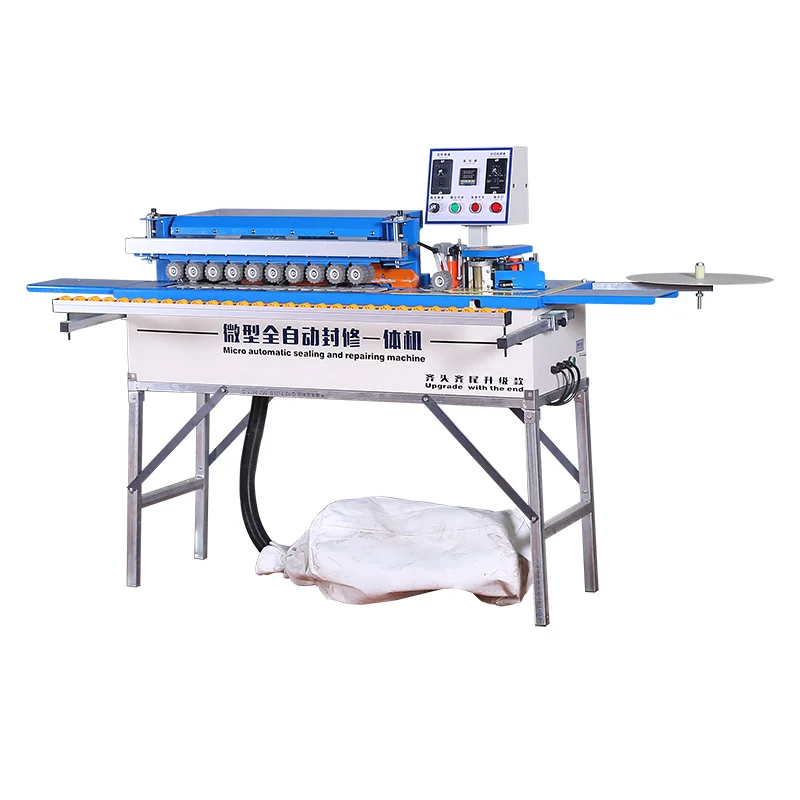
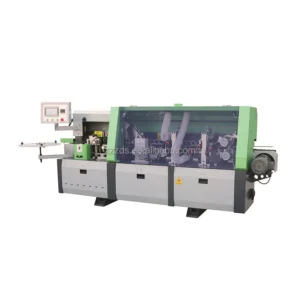
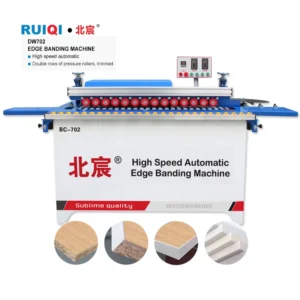
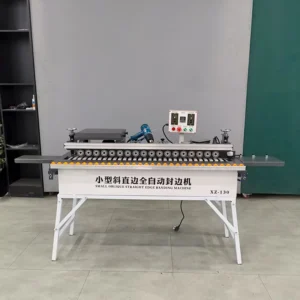
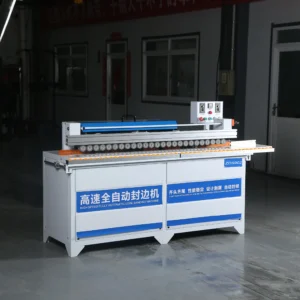
Fast Dispatch, Ready to Run — stocked entry-level edge banders ship quickly with voltage confirmed before crating, so your workshop stays on schedule.
Technical Specifications
| Parameter |
Value |
| Product Type |
Fully Automatic Edge Banding Machine |
| Voltage |
220V (custom 110V–440V available) |
| Total Power |
4000W |
| Feed Speed |
0–6 m/min |
| Glue Pot Capacity |
1000 ml |
| Board Thickness Range |
10–60 mm |
| Edge Banding Thickness Range |
0.5–3 mm PVC |
| Overall Dimensions |
120 × 54 × 72 cm |
| Net Weight |
81 kg (source value — verify against manufacturer catalog) |
| Control System |
Individual function control panel |
| Gluing Type |
Double-sided gluing |
| Trimming Stations |
Up and down edge trimming motors (800W each) |
| Polishing Stations |
Up and down cross polishing motors (180W each) |
| Special Function |
Curved and line dual purpose, gluing device rotates 180° |
| Dust Extraction |
Dust suction device on trimming station |
| Assembly State |
Requires assembly; user manual and video provided |
| Warranty |
1 year |
Application Suitability
| Application |
Material or Output |
| Small workshop cabinet edge banding |
MDF and particleboard panels with PVC edging |
| Custom furniture curved edge finishing |
Plywood and solid wood panels with 0.5–3 mm PVC |
| Joinery startup straight-line production |
Melamine-faced boards up to 60 mm thickness |
| Prototype and short-run panel edging |
Mixed substrates in a compact workshop footprint |
Why the Voltage Question Must Come Before the Order
Confirming your local supply before checkout prevents a three-week standstill on the shop floor.
I watched a Southeast Asian buyer receive an entry-level edge bander wired for the wrong grid. The machine sat idle while a step-down transformer was sourced locally, pushing back production starts and frustrating the operators who had cleared space for it. An Automatic Edge Banding Machine for small workshop buyers should arrive ready to plug in, not ready to negotiate with the local electrician [NEED_CITE: voltage and frequency standards by export market]. When the spec sheet and the wall socket disagree, the delay always lands on the buyer.
Compact Footprint, Straight and Curved in One Pass
Small joinery shops rarely have room for separate straight-line and contour machines. This Automatic Edge Banding Machine for small workshop environments handles both through a 180° rotatable gluing device, letting the operator switch between flat cabinet sides and curved shelving without changing stations. The 120 × 54 × 72 cm frame fits against a wall or between a panel saw and a drill press, keeping material flow tight.
Double-Sided Gluing for Consistent Adhesion
PVC edge banding on particleboard often fails at the glue line when only one surface receives adhesive. The double-sided gluing system coats both the panel edge and the back of the banding strip, producing a bond that survives the humidity swings common in unconditioned workshops. Operators set the feed speed from 0 to 6 m/min on the individual function panel, matching the pace to the substrate without guessing [NEED_CITE: adhesion performance on particleboard versus MDF substrates].
Reading the Numbers That Matter
The 10–60 mm board thickness range covers most cabinet and furniture stock, but the real constraint is the combination of board thickness and feed speed. Thicker panels carry more mass through the trimming zone, so the 800W up-and-down trimming motors need a slower feed to hold a clean cut on heavy chipboard. The 0.5–3 mm PVC edge range suits standard decorative edging; thicker solid-wood lipping falls outside this model's design envelope. Dust suction at the trimming station captures the bulk of PVC and MDF swarf before it settles on the glue pot, extending the interval between clean-outs and keeping the workshop air noticeably clearer.

The Cost of Skipping the Spec Sheet
Buyers who order on footprint alone often discover the board thickness range does not match their heaviest stock, and the trimming motors stall on 50 mm chipboard. Others find the control panel labels are in a language their operator cannot read, turning a half-day commissioning into a week of trial and error. Mismatched feed height between the edge bander and an existing panel saw forces awkward manual handling that chips panel edges before they even reach the glue pot [NEED_CITE: ergonomic injury rates from mismatched machine heights in small workshops]. These problems surface only after the crate is open and the floor bolts are tightened.
Why Source This Machine Here
In-house manufacturing with patented cutting mechanisms means the trimming motors and glue pot are built and tested under one roof, not assembled from third-party kits. Voltage customization from 110V to 440V is confirmed before production, so the machine matches your grid on arrival. A four-stage QC process covers incoming material, in-process assembly, finished product and pre-shipment verification, with a test record generated for every unit. Engineer-led configuration ensures the Automatic Edge Banding Machine for small workshop buyers matches the actual panel sizes and throughput you described, not a generic catalog pick. Factory visits are welcome if you want to see the line before committing.
Documentation & Verification
- CE declaration of conformity for the edge bander and its electrical enclosure
- Machine specification sheet listing verified board and edge thickness ranges
- Electrical schematic confirming voltage and frequency before dispatch
- Factory test record run on your specified panel thickness
- Operation and maintenance manual in the language you agreed at order
- Pre-shipment packing photographs showing crating and component protection
Installation, Commissioning & Support
- Requires a dedicated 220V circuit rated above 4000W with proper earth bonding
- Arrives partially assembled; trimming and polishing stations need on-site mounting per the video guide
- Glue pot first heat-up takes under an hour; load 1000 ml of EVA adhesive and run a test strip
- Individual function control panel allows step-by-step station activation during commissioning
- Up and down trimming motors require belt tension check after the first full production day
- Dust suction port connects to a standard workshop extraction hose at the trimming station
Before You Request a Quote
Share the panel materials you cut most often, the typical board thickness and edge banding thickness, and your local voltage and frequency so the electrical configuration is locked in before the machine enters production. If you run curved components, note the smallest radius you need to edge-band. Let us know whether your operators prefer English, Spanish or another language on the control panel so the manual and labels match from day one.
Frequently Asked Questions
Q: What is the smallest workshop space this machine fits into?
A: The frame measures 120 × 54 × 72 cm, leaving enough clearance in a compact joinery shop when placed between a sliding table saw and a boring machine. You will need roughly one meter of infeed and outfeed space on each side for handling full cabinet panels safely.
Q: Can the voltage be matched to my local supply before shipping?
A: Yes. Standard configuration is 220V, but the machine can be built for any supply from 110V to 440V. Confirm your local voltage and frequency at the inquiry stage so the correct motor windings and control transformer are installed before the unit is crated.
Q: How does the curved and straight dual-purpose function work?
A: The gluing device rotates 180 degrees to follow curved panel contours or lock into a fixed position for straight edges. The operator switches between modes manually on the individual function control panel without adding or removing any tooling.
Q: What assembly is required once the machine arrives?
A: The main frame ships intact, but the trimming motors, polishing motors and dust suction hood need mounting and alignment. The supplied manual and video walk through each step, and most small workshop teams complete setup within a single working shift.
Q: Is there a larger model to move to as production volume grows?
A: The product family includes higher-throughput edge banders with additional trimming and buffing stations. When your daily panel count outgrows the 0–6 m/min feed speed, an upgrade within the same range keeps operator training and spare parts continuity intact.