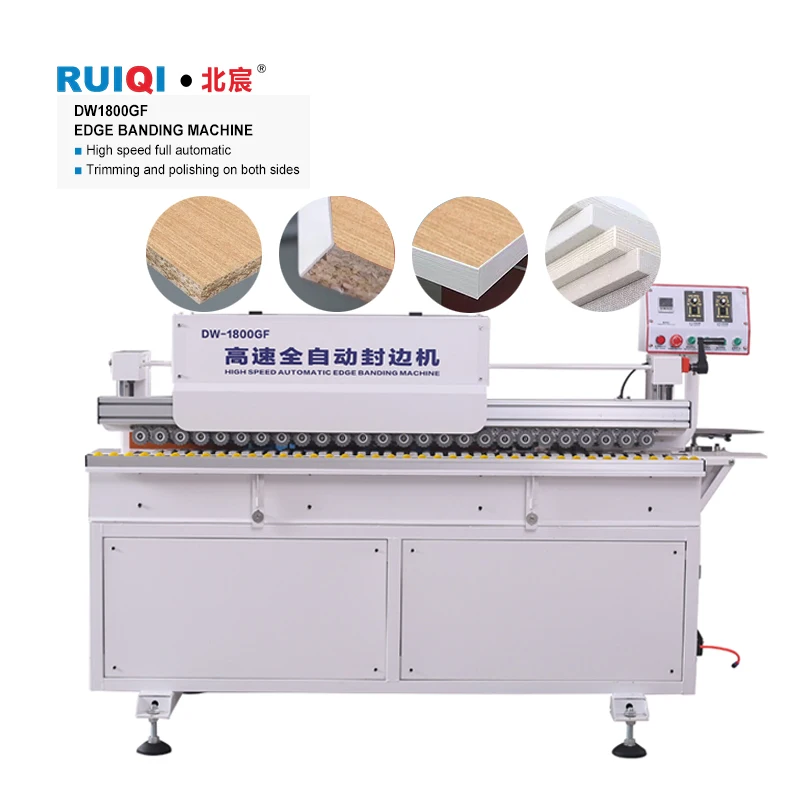
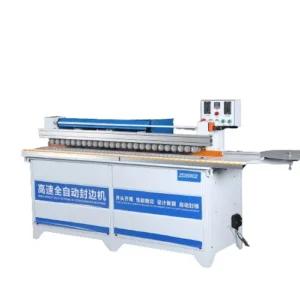
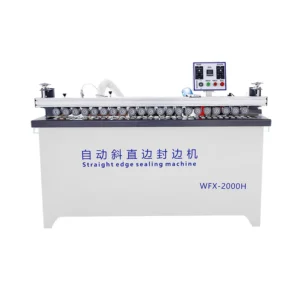
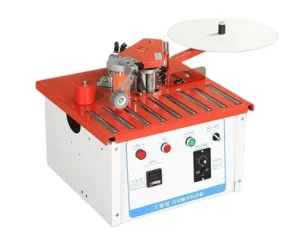
Compact Full-Function Integration — seven edge finishing stations housed within a 220 cm footprint so a small workshop gains machine-grade edging without reconfiguring the floor plan.
Technical Specifications
| Parameter |
Value |
| Model |
DW1800 |
| Product Type |
Automatic Edge Banding Machine |
| Total Power |
4.9 kW |
| Voltage Options |
380V / 220V / 415V (50Hz / 60Hz — confirm before order) |
| Feed Speed |
0–14 m/min |
| Edge Banding Height Range |
0–50 mm |
| Edge Banding Thickness Range |
0.3–3 mm |
| Minimum Sheet Length |
20 cm |
| Minimum Sheet Width |
10 cm |
| Trimming Speed |
24000 r/min |
| Glue Pot Capacity |
4000 ml |
| Air Source Pressure |
0.4–0.6 MPa |
| Overall Dimensions (L×W×H) |
220 × 65 × 125 cm |
| Net Weight |
320 kg |
| Standard Functions |
Gluing, end cutting, rough trimming, fine trimming, profile tracking, scraping, polishing |
| Gluing Method |
Double-sided gluing |
| Guide Structure |
Roll-ball differential mobile table guide |
| Workstation Material |
High-strength extruded aluminum alloy |
| Control System |
PLC |
| Standards |
CE, ISO 9001 |
Application Suitability
| Application |
Material or Output |
| Custom cabinet door edging |
MDF and particleboard with PVC or melamine banding |
| Small-batch furniture panels |
Plywood and blockboard with veneer edge strips |
| Joinery workshop first automation |
ABB boards and organic glass plates up to 50 mm height |
| Shelving and carcass components |
Solid wood panels with 0.3–3 mm banding thickness |
Why the Voltage Question Must Come Before the Quotation
Confirming local supply voltage and frequency is the single most important step before any automatic edge banding machine for small workshop leaves the factory.
I once watched a custom cabinet shop in Southeast Asia take delivery of an entry-level edge bander only to discover their facility ran on a 110V grid while the machine was wired for 220V. The transformer retrofit stalled their line for nearly three weeks. Every panel sat unedged, every cabinet order sat unfulfilled. That failure had nothing to do with the machine's build quality — it was a gap in pre-order communication [NEED_CITE: voltage and frequency standards by export market]. When a workshop is investing in its first automated edger, the excitement around features often overshadows the basic electrical reality of the installation site.

Floor Space That Matches a Startup Workshop
A joinery shop moving from manual edge banding rarely has a dedicated production hall waiting to be filled. The DW1800 occupies a 220 × 65 cm footprint, which means it fits against a wall or between existing bench stations without demanding a facility rearrangement. For a startup furniture maker, that compact footprint keeps the rest of the workshop functional while the new automatic edge banding machine for small workshop takes over the edging process. The 125 cm height clears standard overhead lighting and ventilation ducts in typical light-industrial units.
Seven Stations Without the Industrial Footprint
Most compact edge banders on the market trim functions to save space — offering gluing and rough trimming while leaving polishing or profile tracking to a second machine or manual work. The DW1800 keeps the complete sequence: double-sided gluing, end cutting, rough and fine trimming, profile tracking, scraping, and polishing. A cabinet door panel enters one end and exits with finished edges on all four sides, corners rounded by the tracking station. That means a small shop does not need to budget for a separate corner-rounding jig or a hand-polishing bench downstream.
Reading the Specs Against Your Panel Mix
The 0–14 m/min feed speed range gives operators room to slow down for thick veneer on plywood and speed up for thin PVC on particleboard. Feed speed and banding thickness interact directly — pushing thick wood veneer too fast causes chatter marks on the trimmed edge, while running thin PVC too slowly can overheat the glue film. The 24000 r/min trimming spindle is the spec worth watching here: it keeps the cutter engagement clean across MDF and particleboard alike, reducing the visible scoring that forces panels into secondary sanding [NEED_CITE: edge trimming quality standards in panel furniture]. The 4000 ml glue pot sustains continuous runs through a typical batch of cabinet components without needing a mid-job refill, and the double-sided gluing method ensures bond coverage on both the panel edge and the banding back. The roll-ball differential guide keeps panels tracking straight even when feeding narrower pieces down to 10 cm width.
The Hidden Cost of a Mismatched First Machine
When a small workshop buys an edge bander that lacks profile tracking or polishing, the shop compensates with handwork — a worker with a file and a buffing pad finishing every corner and edge after the machine passes. That manual step introduces inconsistency that becomes visible once the furniture reaches the customer. More critically, a machine underspecified for the shop's actual panel mix will show its limits within months: edge adhesion failures on melamine-faced boards, visible glue lines on porous MDF substrates, and trimming chatter on plywood cores. The shop then faces the choice of living with rejects or buying a second, larger machine — meaning the first purchase was never really an investment but a delayed expense [NEED_CITE: common causes of edge banding adhesion failure on composite panels].
Why Procurement Through This Channel Fits a Growing Workshop
Every DW1800 ships with voltage and plug type confirmed against the buyer's local electrical standard before production begins — the 380V, 220V, and 415V options are not theoretical catalog entries but build-to-order configurations matched to each destination market. The PLC control panel is supplied in Chinese and English as standard, with additional languages configured on request so operators are not decoding instructions in an unfamiliar script during commissioning. Pre-shipment testing runs actual panel samples through the full seven-station sequence, generating a factory test record that travels with the machine. The extruded aluminum alloy workstation resists the warping that stamped steel tables develop after months of clamp pressure, keeping panel registration accurate over the machine's working life. Engineer-led configuration recommendations are formalized in a written quotation within one working day, giving buyers a documented reference before committing.
Documentation & Verification
- CE declaration of conformity covering the full DW1800 assembly and electrical system
- Factory test record documenting edge quality on your specified panel thickness and banding material
- Electrical schematic with confirmed voltage and wiring diagram for your local technician
- Operation and maintenance manual supplied in your agreed language at time of order
- Spare parts list with part numbers matching the components installed in your specific machine
- Packing photographs taken before crate closure for condition verification at delivery
Installation, Commissioning & Support
- Requires a dedicated circuit matching the confirmed voltage option and 4.9 kW total draw
- Fully assembled at factory — position on level floor within the 220 × 65 cm footprint and connect power and air supply
- Air compressor must deliver 0.4–0.6 MPa to the machine's inlet for trimming and tracking actuators
- First-run commissioning includes feed speed calibration and glue temperature setting for your banding material
- Trimming and polishing consumables listed in the spare parts sheet for local sourcing planning
- Glue pot cleaning cycle recommended after each production day to maintain the 4000 ml pot's heating element
What to Prepare Before Requesting a Quotation
To configure the right automatic edge banding machine for small workshop production, share your typical panel materials and thicknesses, the edge banding types and widths you run most often, and your local supply voltage and frequency. If your shop already has upstream panel saws or downstream boring equipment, mention their feed heights and throughput so the line can be balanced. Let us know your preferred control panel language and whether you need plug type EU, USA, AU, or UK — these are set during build, not adjusted on site.
Frequently Asked Questions
Q: What voltage and plug options are available, and can you match my country's standard?
A: The DW1800 is built to order in 380V, 220V, or 415V configurations, with 50Hz or 60Hz frequency matched to your local grid. Plug types available include EU, USA, AU, and UK standards. We confirm the exact voltage, frequency, and plug with you before production starts, so the machine connects directly to your existing supply without a transformer.
Q: Will this machine handle my current volume, or will I outgrow it quickly?
A: The DW1800 covers the full edge finishing sequence — gluing through polishing — at feed speeds up to 14 m/min, which suits small-to-medium batch production typical of startup joinery shops and custom cabinet makers. When your volume grows to require continuous high-speed line production, the machine remains useful as a secondary or sample-room unit rather than becoming redundant.
Q: What panel materials and edge banding thicknesses does it handle?
A: The machine processes MDF, particleboard, plywood, ABB boards, PVC panels, organic glass plates, and solid wood panels. Edge banding thickness range is 0.3–3 mm, and the banding height range covers 0–50 mm. The double-sided gluing system and 24000 r/min trimming spindles maintain clean edge quality across these material variations.
Q: Can the control panel display in English or another language?
A: Chinese and English are standard language options on the PLC interface. Additional languages are configured on request during the build phase, so the operator sees all menus and alerts in a readable language from the first day of operation. This avoids commissioning delays caused by unfamiliar interface text.
Q: How is the machine packed and what do I need to prepare on site?
A: The DW1800 ships fully assembled — no station modules to bolt together on arrival. You need a level floor space of 220 × 65 cm, a dedicated electrical circuit at the confirmed voltage, and an air compressor delivering 0.4–0.6 MPa. Packing photographs are taken before dispatch so you can verify external condition upon delivery.