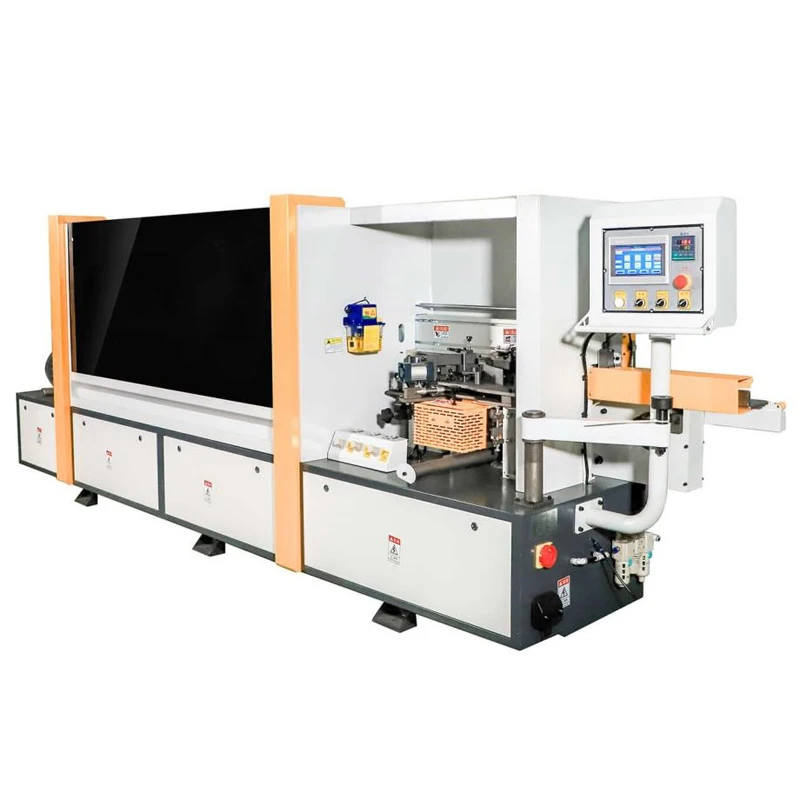
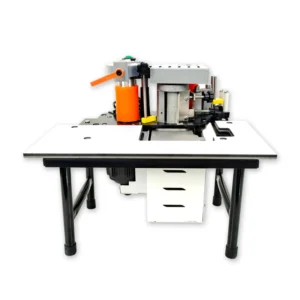
Ready stock, fast dispatch — ZDS-468J units held in inventory for quick release once voltage and control panel language are confirmed against your workshop supply.
Technical Specifications
| Parameter |
Value |
| Model |
ZDS-468J |
| Product Type |
Automatic Edge Banding Machine |
| Main Functions |
Pre-milling, Gluing, End trimming, Rough trimming, Fine trimming, Corner rounding, Scraping, Buffing |
| Trimming Stations |
8 |
| Working Pressure |
0.6 Mpa |
| Panel Thickness Range |
10–60 mm |
| Edge Thickness Range |
0.4–3 mm |
| Min. Panel Size |
300×60 mm / 150×150 mm |
| Voltage |
380V-3HP |
| Rated Power |
16 kW |
| Net Weight |
2000 kg |
| Overall Dimensions (L×W×H) |
6600×900×1600 mm |
| Feed Speed |
(basis to be confirmed) |
| Glue Pot Temperature |
(basis to be confirmed) |
| Dust Extraction Port |
(basis to be confirmed) |
| Control System |
(basis to be confirmed) |
| Language Options |
(basis to be confirmed) |
| Warranty |
1 year |
Application Suitability
| Application |
Material or Output |
| Custom cabinet door edging |
MDF and particleboard with PVC edge banding |
| Drawer front and small component finishing |
Plywood panels down to 150×150 mm |
| Joinery workshop panel edging |
Solid wood panels with veneer edge banding |
| Shelving and carcass production |
Particleboard with 0.4–3 mm PVC or melamine banding |
Why the Voltage Question Must Come Before the Order
Confirming your workshop supply before ordering avoids weeks of idle equipment on the floor.
I have watched small cabinet shops take delivery of an Automatic Edge Banding Machine entry-level small workshop operators assumed would plug straight in, only to find the 380V three-phase requirement did not match the single-phase supply in their unit. The machine sat wrapped while a transformer was sourced and installed. That delay is entirely avoidable [NEED_CITE: voltage and frequency standards by export market]. When a joinery startup is spending its first capital on automated edging, two weeks of lost production is the difference between hitting a client deadline and losing the contract.

Matching the Machine to Your Current Volume
This 8-station configuration handles the full workflow from pre-milling through buffing in a single pass. For a workshop currently trimming edges by hand or with a portable router, moving to a stationary Automatic Edge Banding Machine entry-level small workshop configuration removes the secondary finishing step that typically bottlenecks output. The pre-milling station cleans the panel edge before glue application, which matters when working with particleboard that has saw marks from the panel saw.
Where This Model Sits in a Growing Workshop
The ZDS-468J is designed for shops producing custom cabinet runs and small batch joinery rather than continuous high-volume production. When daily output grows beyond what a single-shift operation on this frame can sustain, the next step is a higher feed-speed model with a larger glue pot and automated return conveyor. Buying into a product family that scales means the operator skills and maintenance routines transfer directly [NEED_CITE: typical production volume thresholds for entry-level edge banding equipment].
Reading the Specs That Actually Matter
The 10–60 mm panel thickness range covers standard MDF, particleboard, and plywood used in cabinet carcass and door production. Below 10 mm, thin panels tend to deflect under feed pressure and require a machine with a narrower gap setting. The minimum panel size of 150×150 mm is relevant when processing small drawer fronts or narrow filler strips — anything smaller will not register against the feed fence correctly. The 0.6 Mpa working pressure requirement means your compressor must deliver stable air to the pneumatic cylinders controlling the trimming and scraping stations; pressure drops cause inconsistent corner rounding. The 2000 kg net weight provides a stable base that resists vibration during end trimming, which directly affects edge finish consistency. The 16 kW rated power draw requires a dedicated circuit — sharing a breaker with other equipment risks tripping during glue pot heat-up.
The Hidden Cost of Skipping Configuration Checks
Ordering an edge bander without verifying the glue pot temperature range against your chosen banding material leads to adhesion failures discovered only after panels reach the customer. PVC banding and wood veneer require different temperature windows, and a pot that runs too hot will degrade the adhesive on thinner PVC stock. Similarly, specifying a control panel in a language the operator cannot read stalls commissioning and forces the shop owner to serve as full-time translator during setup [NEED_CITE: operator training and control panel language requirements for imported machinery].
Why Source Through This Channel
Stocked ZDS-468J units can be dispatched on a shorter lead time than built-to-order configurations, which matters when a workshop needs to replace a failed machine or meet a project deadline. Voltage is confirmed against your local supply before release — the 380V-3HP specification is verified, or an alternative is arranged. Operation and maintenance manuals are supplied in the language agreed at order, so operators can follow setup procedures from day one. Factory test records on your specified panel material and edge banding thickness are provided before the machine leaves the floor. A formal quotation with confirmed specifications is typically available within 24 hours of a complete inquiry.
Documentation & Verification
- CE declaration of conformity for the ZDS-468J edge bander
- Electrical schematic confirming 380V-3HP wiring and breaker rating
- Factory test record on your panel thickness and edge material
- Operation manual in agreed language covering all 8 stations
- Spare parts list with part numbers for trimming blades and scrape inserts
- Packing photographs showing crate condition before dispatch
Installation, Commissioning & Support
- 6600×900 mm footprint requires clear floor space with level concrete base
- 16 kW rated power demands a dedicated 380V three-phase circuit
- Machine ships assembled; positioning requires forklift access to the 2000 kg frame
- First-run parameter setup covers glue temperature, feed pressure, and trim depth
- Dust extraction ports must connect to your workshop collection system before operation
- Operator training covers all 8 stations from pre-milling adjustment through buffing wheel replacement
What to Include in Your Inquiry
Share the panel materials and edge banding types you plan to run most often, along with typical panel dimensions. Confirm your workshop voltage and phase supply — a photo of the main distribution board removes any guesswork. If you have a target daily output in linear meters of edged panel, include that so feed speed can be matched to your schedule.
Frequently Asked Questions
Q: What production volume is this entry-level edge bander realistically designed for?
A: The ZDS-468J suits custom cabinet shops and joinery startups running small to medium batch sizes rather than continuous mass production. It handles single-shift operation on standard MDF, particleboard, and plywood panels. When your daily throughput consistently exceeds what a single-shift schedule supports, the upgrade path moves to a higher feed-speed model within the same product family.
Q: Is 380V-3HP compatible with my workshop supply?
A: The standard ZDS-468J configuration is 380V three-phase. Before ordering, confirm your workshop supply matches this requirement. Voltage customization from 110V to 440V is available on request. Providing a photo of your main electrical panel at the inquiry stage allows the correct configuration to be quoted without delay or guesswork.
Q: Can the control panel be supplied in my local language?
A: Multilingual control panels are available. Specify the required language during the quotation stage so the interface and operation manual match your operator's working language. This avoids commissioning delays and ensures the team can independently adjust station parameters from the first day of production.
Q: How do I verify edge quality on my own material before ordering?
A: Request a sample processing test or factory test video using your specific panel material and edge banding stock. The test record documents trimming accuracy, glue adhesion, and corner rounding finish on your actual substrate, giving you verifiable evidence rather than a general specification claim.
Q: What is the upgrade path when my workshop outgrows this machine?
A: The product family includes higher feed-speed models with additional automation features such as automatic return conveyors and larger glue pots. Operator skills and maintenance routines developed on the ZDS-468J transfer directly, reducing the learning curve when scaling to a higher-throughput configuration.