Engineer-Led Configuration Recommendation — Formal quotation with voltage and feed speed confirmation within one working day so your small workshop can plan the next equipment step without waiting.
Technical Specifications
| Parameter |
Value |
| Product Type |
Automatic Edge Banding Machine |
| Overall Dimensions (L×W×H) |
435×92×165 cm |
| Total Power |
17.5 kW |
| Voltage & Frequency |
380V / three-phase five-wire / 50Hz (configurable from 110V to 440V) |
| Conveying Motor |
380V 2.2 kW with frequency converter |
| Feed Speed |
0–12 m/min (variable, inclined straight edge) |
| Glue Pot Temperature Range |
150–170°C |
| Glue Pot Capacity |
2000 mL |
| Edge Strip Width |
20–50 mm |
| Edge Banding Thickness |
Up to 1.2 mm |
| Panel Thickness Range |
18 mm / 22 mm / 25 mm |
| Minimum Panel Dimensions |
>100 mm width, >250 mm length |
| Air Source Pressure |
0.6–0.8 MPa |
| Air Storage Tank Volume |
5 L |
| External Dust Extraction Port |
100 mm diameter |
| Control System |
Xinjie industrial touch screen with Xinjie industrial inverter |
| Trimming Motor |
380V 0.75 kW × 2 |
| End Cutting Motor |
380V 0.37 kW × 2 |
| Polishing Motor |
380V 0.37 kW × 2 |
| Milling Motor B |
380V 3.5 kW |
| Warranty |
1 year |
Application Suitability
| Application |
Material or Output |
| Custom cabinet door edge finishing |
MDF and particleboard with PVC edge strip |
| Small-batch furniture production |
Plywood panels up to 25 mm thickness |
| Decorative bevel edge work |
45° bevel profile on standard panel stock |
| Workshop transition from manual banding |
Machine-applied PVC edges on melamine-faced board |
| Shelving and carcass panel finishing |
Straight edge PVC banding on 18 mm substrate |
Why Voltage Confirmation Comes Before Everything Else
An Automatic Edge Banding Machine for Small Workshop use that arrives with the wrong voltage will not run at all — it becomes a heavy crate in the middle of your floor.
I have seen small joinery shops excited about a new edge bander only to find it wired for 380V/50Hz while their facility runs on 220V/60Hz. The motor will not start, the glue pot will not heat, and by the time a step-down transformer is sourced, the installation timeline is already two weeks behind. Small workshops rarely have a second incoming power line to fall back on.
This is why voltage and frequency confirmation happens at the quotation stage here, not after the machine is crated. The standard configuration is 380V three-phase five-wire at 50Hz, but the electrical system is configurable. A small startup in a region with different grid standards needs to confirm this before production begins, not after delivery [NEED_CITE: voltage and frequency standards by export market]. The cost of getting this wrong is not just the transformer — it is the idle time while your operators wait to start producing.

What a 435 cm Footprint Means for Your Floor Plan
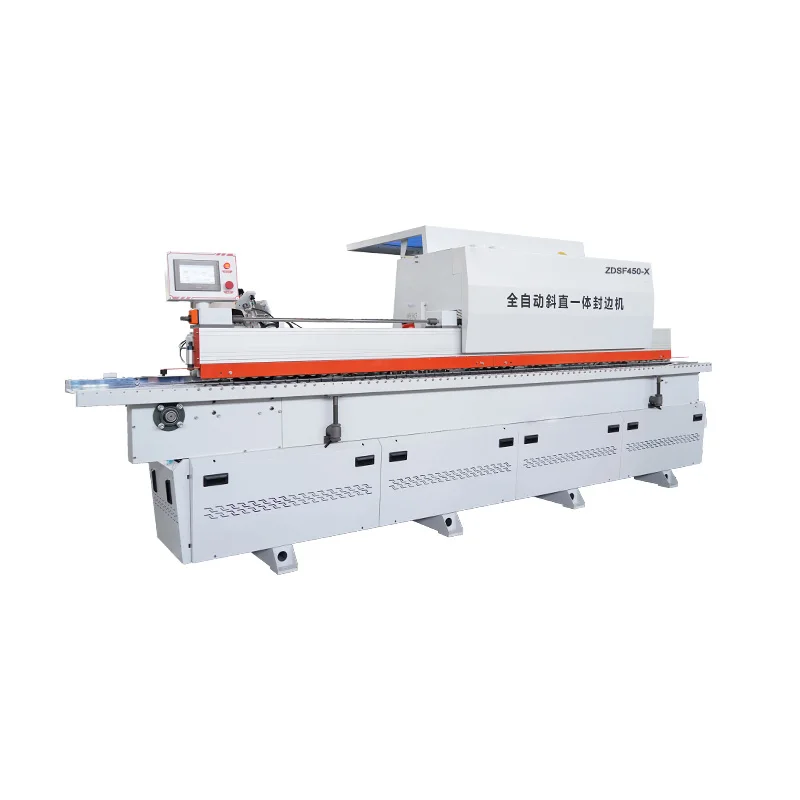
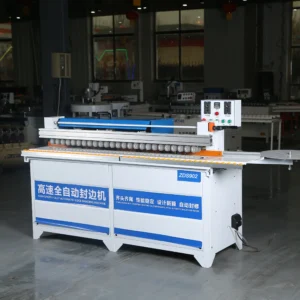
Most small workshops do not have a dedicated machine room with clear walls on all sides. This Automatic Edge Banding Machine for Small Workshop environments fits along a single wall at 435 cm long, 92 cm wide, and 165 cm tall, leaving room for a panel cart on the infeed side and a stacking table on the outfeed. The compact footprint means you can place it between a sliding table saw and a boring machine without rearranging your entire floor layout.
The 100 mm dust extraction port is positioned for standard flexible ducting, so you can connect to an existing central collector or a standalone extraction unit without custom fabrication.
The Difference Between Straight-Only and Bevel-Capable Banding
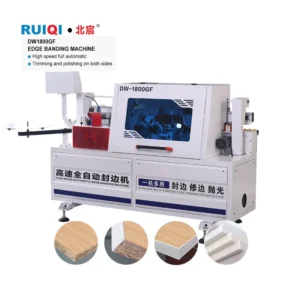
Many entry-level edge banders handle only 90° straight edges, which forces a workshop to either outsource bevel work or buy a second machine. This unit processes both straight and 45° bevel edges on the same frame. For a small custom cabinet maker, this means a single operator can produce standard carcass panels and decorative beveled door fronts on the same shift without moving material between stations.
The variable feed speed from 0 to 12 m/min lets operators slow down for thicker PVC strip or tricky bevel cuts where edge contact time matters. Rushing a bevel edge at maximum speed risks incomplete trimming and visible glue lines, especially on melamine-faced substrates where surface tension behaves differently than bare MDF [NEED_CITE: edge banding adhesion behavior on melamine versus raw MDF surfaces].
How Glue Pot Temperature Affects the Edge You Deliver
The 150–170°C glue pot range is not arbitrary. PVC edge strip at 1.2 mm thickness requires sufficient heat to activate the adhesive layer and bond under roller pressure. If the temperature drops below range — common when a workshop runs cold panels in winter without pre-conditioning the material — the bond weakens and edges lift during the trimming stage.
The 2000 mL glue pot capacity provides enough volume for continuous runs without frequent refills, which matters when a small shop is pushing through a kitchen order of forty or fifty panels. The slotted motor at 220V 0.8 kW handles grooving tasks independently, so the main feed does not need to stop for auxiliary operations. Panel thickness settings at 18, 22, and 25 mm cover the three most common board gauges in custom furniture, meaning the adjustment between jobs is a quick dial turn rather than a tooling change.
The Cost of Skipping the Sample Test
When a small workshop orders an edge bander based solely on a spec sheet, the first panel through the machine on delivery day becomes the real test. I once worked with a cabinet shop that specified PVC strip for their entire kitchen line, ran successful samples, and then switched to melamine-faced board for a bathroom project without adjusting the glue temperature. The edges bubbled within hours, and the entire batch of doors came back for rework.
A pre-shipment sample test using your actual panel material and edge strip eliminates this guesswork before the machine leaves the factory. Small workshops cannot absorb a full batch of rework the way larger plants can — every scrapped panel comes directly out of a thin margin [NEED_CITE: rework cost impact on small furniture manufacturers].
Why Procurement Works Differently Here
Voltage, language, and specification customization are treated as standard configuration steps, not premium upgrades. A small workshop in Southeast Asia needs the same level of electrical matching as a distributor ordering ten units.
The control panel language is set before dispatch based on the operator who will actually run the machine — not whoever signed the purchase order. This matters because a Xinjie touch screen displaying instructions in an unreadable language will stall commissioning for days.
Four-stage quality control covers incoming material inspection through pre-shipment verification, so the machine you receive has been tested against its own specifications, not just powered on.
Engineer-led configuration means someone reviews your panel thickness range, feed speed needs, and edge profile requirements before quoting — rather than shipping a default model and hoping it fits.
Factory visits are available for buyers who want to see the assembly process and run their own test panels before committing.
Documentation & Verification
- CE declaration of conformity covering this machine class for your import market
- Electrical schematic showing the confirmed voltage and wiring configuration
- Factory test record using your specified panel thickness and PVC strip
- Operation manual in the agreed language matching the touch screen display
- Spare parts list with part numbers for trimming cutters and feed rollers
- Packing photographs before crate closure for shipping verification
Installation, Commissioning & Support
- Requires a dedicated 380V three-phase circuit rated for the 17.5 kW total power draw
- Position with 100 mm dust port accessible to your extraction system or standalone collector
- Arrives with the 5 L air storage tank; connect to a compressor supplying 0.6–0.8 MPa
- First run includes feed speed calibration from 0 to 12 m/min on your actual panel stock
- Xinjie touch screen configured in your chosen language before the machine leaves the factory
- Trimming and polishing cutter replacement schedule included in the maintenance manual
What to Share When You Start an Inquiry
Send your primary panel material (MDF, particleboard, or plywood), the thicknesses you run most often, and the PVC edge strip width and thickness you plan to use. Confirm your workshop voltage and frequency at the main panel — not a guess based on neighboring businesses.
Let us know if you need the control interface in a specific language and whether you want to run a sample test on your own board stock before the machine ships. If you are planning to add a sliding table saw or boring machine later, mention that so the feed height and panel handling can be coordinated from the start.
Frequently Asked Questions
Q: What is the smallest panel this machine can handle and what are the thickness options?
A: The minimum panel size is greater than 100 mm wide and greater than 250 mm long. Thickness settings are 18 mm, 22 mm, and 25 mm, which covers standard MDF and particleboard used in cabinet carcass and door production. Switching between thicknesses involves a mechanical adjustment at the feed station.
Q: Do I need a separate air compressor, and what pressure is required?
A: Yes, you need an external compressor supplying 0.6–0.8 MPa to operate the pneumatic functions. The machine includes a 5 L air storage tank to buffer pressure fluctuations. Most small workshops already running pneumatic tools have a compressor that meets this requirement with a simple line connection.
Q: Can the control panel language be set to my local language?
A: The Xinjie industrial touch screen can be configured in your required language before the machine ships. This is confirmed during the specification stage so that when your operator powers on the machine, all menus and prompts are immediately readable without translation delays during commissioning.
Q: Is the voltage configurable for my country's electrical standard?
A: The standard build is 380V three-phase five-wire at 50Hz, but the electrical system supports configuration from 110V to 440V. Voltage and frequency are confirmed at the quotation stage so the motors, inverters, and glue pot heater are all matched to your workshop supply before assembly begins.
Q: What does the upgrade path look like as my workshop volume grows?
A: This machine serves as an entry point with both straight and 45° bevel capability. As daily panel volume increases, the next step typically involves adding a pre-milling station or moving to a higher feed speed model within the same product family, keeping operator familiarity with the control system intact.