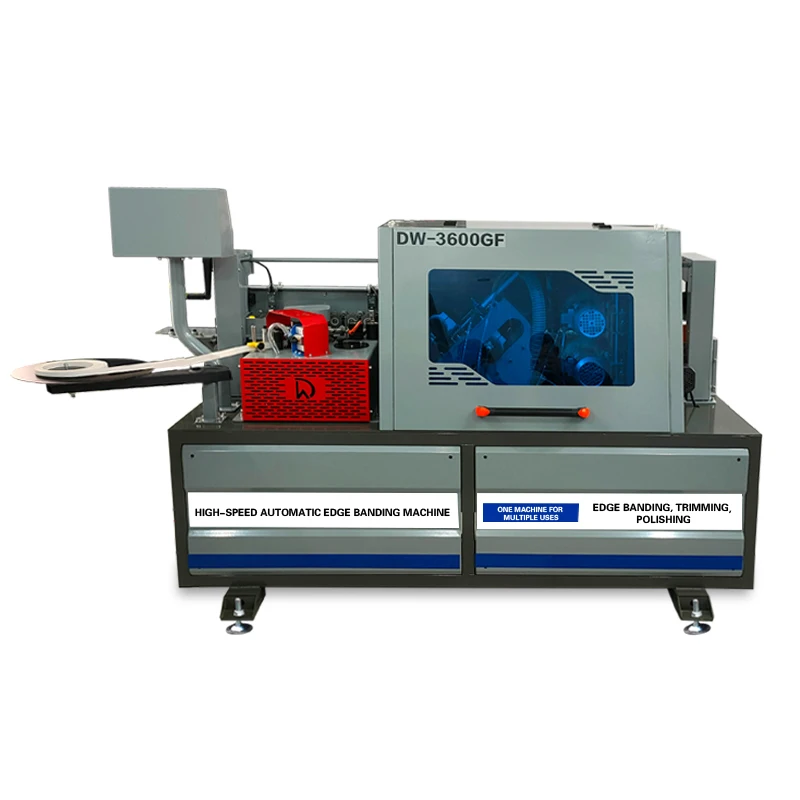
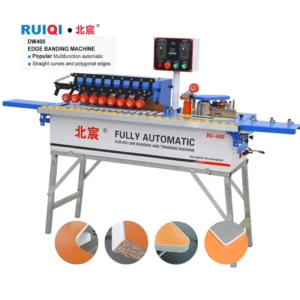
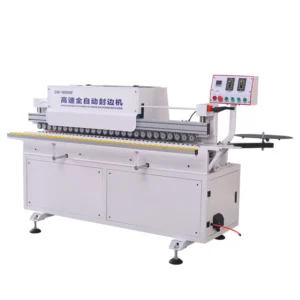
Full-function straight-line banding — gluing through polishing completed in one pass on a 2200mm footprint, ready to ship with voltage confirmed before dispatch.
Technical Specifications
| Parameter |
Value |
| Model |
DW-3600GF |
| Product Type |
Automatic Edge Bander |
| Voltage & Frequency |
380V three-phase four-wire (frequency 50Hz/60Hz to confirm) |
| Total Power |
4.9kW |
| Overall Dimensions (L×W×H) |
2200×650×1250mm |
| Net Weight |
320kg |
| Edge Banding Type |
Straight edge banding |
| Edge Band Height Range |
0–50mm |
| Edge Band Thickness Range |
0.3–3mm |
| Minimum Panel Length |
200mm |
| Feed Speed |
0–14m/min |
| Gluing Motor Power |
160W |
| Transmission Motor Power |
180W |
| Trimming Motor Power |
800W×2 |
| Trimming Motor Speed |
24000r/min |
| Polishing Motor Power |
400W×2 |
| Air Supply Requirement |
0.4–0.6MPa |
| Standard Functions |
Gluing, trimming, front and rear trimming, scraping, polishing, vacuuming |
| Language Options |
Chinese and English standard; Spanish and other languages customizable |
| Plug Options |
EU, USA, AU, UK |
Application Suitability
| Application |
Material or Output |
| Joinery workshop upgrading from hand trimming to automated banding |
PVC edge banding on MDF cabinet panels |
| Startup cabinet maker running small batches |
Melamine and PVC edge banding on particleboard |
| Small furniture factory adding first edge bander |
Veneer and PVC straight-edge banding on plywood |
| Custom furniture shop producing wardrobe and cabinet doors |
MDF and particleboard with 0.3–3mm band thickness |
Why Matching Edge Band Material to Machine Settings Matters More Than You Think
Confirm your actual banding material before the machine ships, not after the first production run fails.
I once worked with a custom cabinet maker who bought an entry-level automatic edge bander for small workshop use. We set up the glue temperature and feed speed based on his sample PVC stock, and the panels ran perfectly. Then his regular production order came in with melamine edge banding — completely different thermal behavior. The glue pot was too cool for melamine adhesion, and the feed rate left insufficient bonding time. Edge bands peeled off during assembly, trimming left residue, and the entire batch went back for rework. The machine was fine; the settings were wrong for the material [NEED_CITE: adhesion requirements for melamine versus PVC edge banding at different feed speeds].

Dispatch Speed Without Sacrificing Setup Accuracy
This automatic edge bander for small workshop environments stocks in configurations covering the most common straight-line banding needs. The unit ships with gluing, front and rear trimming, scraping, polishing, and vacuuming built into a single pass. For a workshop moving away from handheld routers and manual trimming jigs, having all six functions on one frame eliminates the bottleneck of transferring panels between separate stations. Stock-ready ordering means the typical multi-week lead time for custom-built machines does not apply here — the focus is on getting your first automated edge banding line running as soon as your site is prepared.
Choosing the Right Configuration Before You Commit
The emphasis at this stage is matching the DW-3600GF to your actual panel stock and edge band supply chain. Edge band thickness range from 0.3mm to 3mm covers standard PVC, melamine, and thin veneer materials commonly used in cabinet and wardrobe production. If you primarily run thicker solid wood lipping beyond 3mm, a different machine class is needed. Voltage and plug type must be confirmed against your local supply before the unit leaves the factory — a 380V three-phase machine arriving at a site with only single-phase power becomes a heavy decoration until an electrician sorts it out [NEED_CITE: industrial voltage and frequency standards by export market].
How Feed Speed and Trimming Motors Shape Your Daily Output
The variable feed speed from 0 to 14m/min lets operators dial in the pace for different material combinations. Running PVC edge banding on MDF at higher feed rates works because PVC bonds quickly at moderate glue temperatures. Melamine and veneer, however, need slower feeds to allow full adhesive contact and proper cooling before the trimming station engages. The twin 800W trimming motors running at 24000r/min produce a clean shear cut on most banding materials within the thickness range, and the twin 400W polishing wheels remove the fine haze left by scraping. For panels shorter than 200mm, the machine cannot maintain stable feed contact — that minimum length is set by the distance between the infeed pressure rollers and the first trimming unit. Matching feed speed to material is the single largest factor separating a smooth edge from one that shows glue lines under workshop lighting.
The Hidden Cost of Buying a Single Machine Without Thinking Ahead
When a workshop buys an edge bander in isolation, the next problem often surfaces when a panel saw upstream produces cuts that the bander cannot accept due to feed height mismatch, or when a downstream boring machine expects panels trimmed to a tolerance the bander was never set to achieve. Entry-level machines placed into production volumes they were not designed for will show wear on the trimming bearings and feed chain sooner than expected [NEED_CITE: mechanical wear patterns on light-duty edge banders running beyond rated daily volume]. The DW-3600GF suits small-batch and startup production; if your order book grows to continuous full-shift operation, the conversation should shift toward a heavier-duty model rather than pushing this unit past its design intent.
What Backs This Machine Beyond the Spec Sheet
In-house manufacturing with patented cutting mechanisms means the trimming and scraping assemblies are built and tested under the same roof, not sourced from third-party vendors and bolted together. Four-stage quality control — incoming material, in-process, finished product, and pre-shipment verification — catches tolerance drift before the crate closes. Voltage, plug type, and control panel language are confirmed in writing before production starts, not assumed from a default setting. A formal quotation with full configuration detail arrives within 24 hours of a confirmed inquiry, and the factory welcomes site visits for buyers who want to see their panel stock run through the machine before committing.
Documentation & Verification
- Factory test record run on your specified edge band thickness and panel material
- Electrical schematic confirming voltage, frequency, and plug type for your country
- CE declaration of conformity for import clearance
- Operation and maintenance manual in your agreed language
- Spare parts list with part numbers for trimming blades and polishing wheels
- Packing photographs showing crate condition before dispatch
Installation, Commissioning & Support
- Requires a level concrete floor supporting the 320kg net weight across the 2200×650mm footprint
- Dedicated 380V three-phase circuit with correct amperage for the 4.9kW total load
- Connect compressed air at 0.4–0.6MPa before first startup to operate pneumatic pressure rollers
- Glue pot temperature calibrated to your specific edge banding material during commissioning
- Trimming and scraping stations adjusted on your sample panels to verify edge finish quality
- Spare trimming blades and polishing wheels included for initial production period
What We Need to Move Forward
Send us your typical panel material and thickness, the edge banding type and thickness you run most often, and your local voltage and frequency so we can confirm the correct electrical configuration. If you are planning additional machines upstream or downstream, let us know the existing equipment models so we can check feed height and throughput compatibility. For buyers who want to see the machine process their own stock before ordering, we can arrange a sample processing test at the factory.
Frequently Asked Questions
Q: What is the smallest panel this edge bander can process?
A: The minimum panel length is 200mm. This limit is set by the distance between the infeed pressure zone and the first trimming station. Panels shorter than this cannot be held firmly enough through the full gluing, trimming, scraping, and polishing sequence. For very small offcut pieces, a manual edge banding approach remains more practical.
Q: How do I confirm voltage and plug type for my country?
A: Tell us your local supply voltage, phase, and frequency at the inquiry stage. The DW-3600GF is configured for 380V three-phase four-wire supply, and plug options include EU, USA, AU, and UK standards. We confirm the exact electrical specification in the formal quotation before the machine enters production so it arrives ready to connect.
Q: Can the control panel language be set to something other than Chinese and English?
A: Chinese and English are standard on the control interface. Spanish and other languages are available as customization options. Specify your preferred language during the inquiry so the panel labeling and on-screen menus are set before the unit ships, avoiding delays at commissioning.
Q: What upgrade path exists when my production volume outgrows this model?
A: The DW-3600GF is the entry point in a full product family. When your daily volume moves beyond small-batch startup production, the next tier adds higher feed speeds, additional trimming and corner-rounding stations, and heavier-duty feed mechanisms. Staying within the same product family keeps operator training and spare parts commonality intact.
Q: What air compressor specification do I need for installation?
A: The machine requires a compressed air supply between 0.4 and 0.6MPa. This powers the pneumatic pressure rollers and certain trimming actuators. A standard industrial reciprocating or screw compressor rated for continuous duty at this pressure range is sufficient. Confirm your compressor output capacity before the installation date.