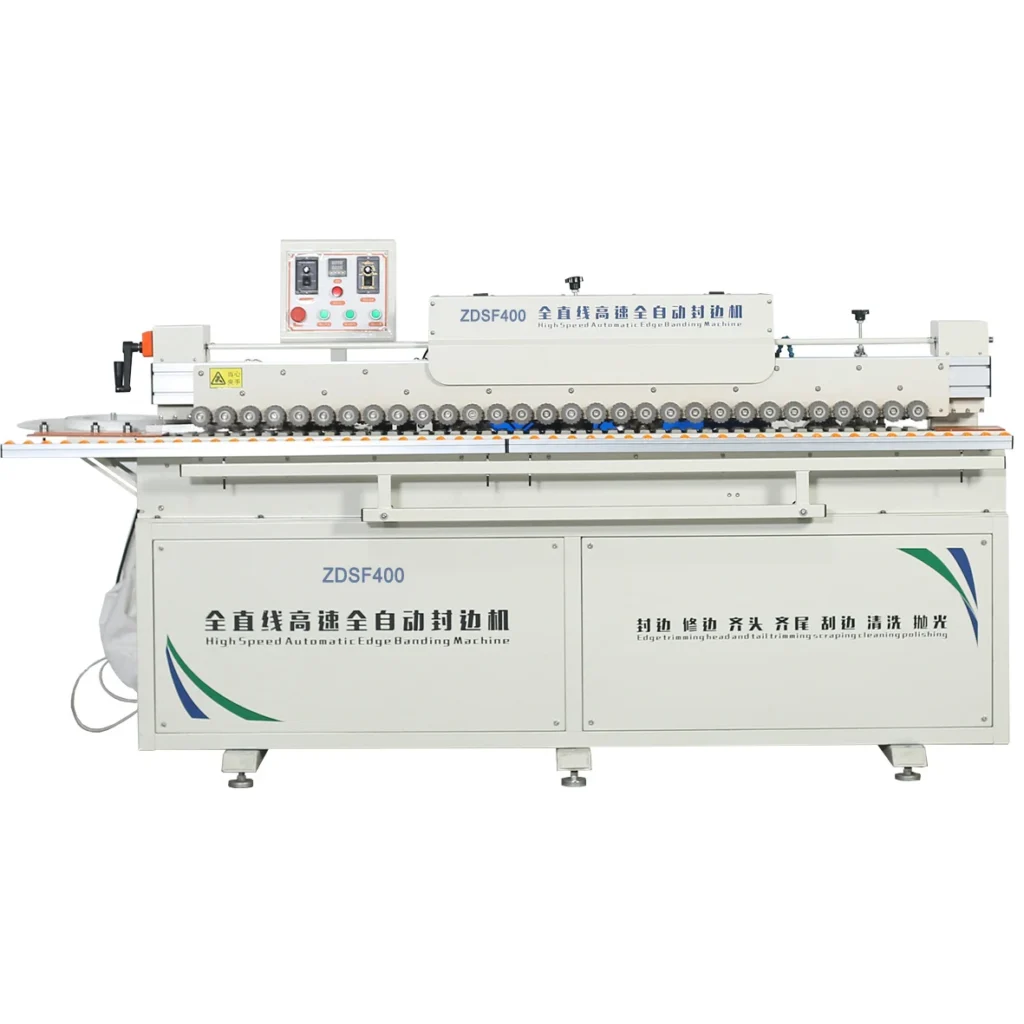
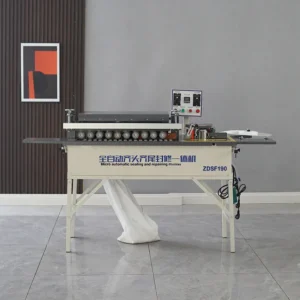
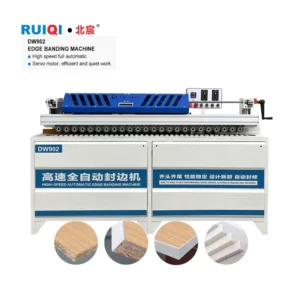
Stocked and Ready — This ZDSF400 automatic edge banding machine sits in our warehouse prepared for single-unit dispatch, cutting the typical multi-week wait for small workshops moving to their first automated edge finisher.
Technical Specifications
| Parameter |
Value |
| Model |
ZDSF400 |
| Product Type |
Automatic Edge Banding Machine |
| Function Sequence |
Gluing, End Cutting, Trimming, Scraping, Polishing, Vacuuming |
| Edge Processing Type |
Straight Line |
| Rated Voltage |
220V |
| Rated Power |
3 kW |
| Rated Air Pressure |
0.4-0.6 MPa |
| Strip Thickness Range |
1-3 mm |
| Sheet Thickness Range |
10-55 mm |
| Feed Speed |
0-14 m/min |
| Conveyor Belt Speed |
0-14 m/min |
| Glue Pot Capacity |
1000 ml |
| Glue Heating Power |
800 W |
| Trimming Motor Power |
800 W × 2 (24,000 rpm) |
| Polishing Motor Power |
180 W × 2 (5,500 rpm) |
| Suction Power |
550 W |
| Overall Dimensions (L×W×H) |
240 × 70 × 120 cm |
| Net Weight |
370 kg |
| Assembly State |
Requires assembly upon arrival |
| Warranty |
1 year (factory-defect spare parts replacement) |
Application Suitability
| Application |
Material or Output |
| Small furniture workshop production |
MDF, particleboard, and plywood panels for custom cabinets |
| Home-decoration joinery operations |
Solid wood panels and blockboard for interior fittings |
| PVC edge strip processing |
1-3 mm PVC strips on straight-line panel edges |
| Veneer edge banding |
Thin wood veneer strips for visible furniture surfaces |
| Low-volume custom cabinet runs |
Straight-edge components requiring consistent trimming and polishing |
Why the Language on Your Control Panel Matters More Than the Feed Speed
An automatic edge banding machine in stock is useless if the operator cannot read the screen.
I spent years on assembly floors in Shandong, and one shipment changed how I view every export order. A straight-line bander landed in a Middle East workshop, powered on, and the commissioning stalled immediately — the control interface was entirely in Chinese. The local team had no way to adjust glue temperature, interpret fault codes, or set feed parameters. The machine sat idle while we scrambled to send translated manuals and arrange remote guidance. Since that day, I verify the language version of every control panel three times before it leaves the factory floor. This ZDSF400 ships with a confirmed multilingual interface matched to your operator's language, so the first day on your shop floor is a productive day, not a troubleshooting session [NEED_CITE: multilingual HMI requirements for exported industrial machinery].

Sizing the Entry Point Correctly
The decision to buy a first automatic edge banding machine in stock often comes after months of hand-held manual banding — inconsistent glue lines, uneven trimming, and operator fatigue. The ZDSF400 addresses this transition directly with a six-function straight-line workflow compressed into a 2.4-meter footprint. Gluing, end cutting, rough trimming, fine scraping, polishing, and vacuuming all happen in a single pass at feed speeds up to 14 m/min. For a joinery startup or home-decoration contractor, this means one operator can produce consistently finished panel edges without the floor space demands of a full production line.
Stock Availability Versus Build-to-Order Delays
Most small workshops cannot absorb a six-to-eight-week lead time when a client's cabinet installation date is fixed. The ZDSF400 is held as a stocked unit, meaning the machine is assembled, tested, and prepared for dispatch rather than entering a production queue. This matters for businesses that win contracts on responsiveness. A stocked automatic edge banding machine also means the unit has already passed the factory's internal test cycle — glue pot heating verified, trimming motors run under load, conveyor belt tension checked [NEED_CITE: pre-shipment inspection standards for woodworking machinery exports].
What the Specifications Mean on Your Workshop Floor
The 10-to-55 mm sheet thickness range covers the majority of panel stock a small furniture shop encounters, from thin 10 mm MDF shelving to 55 mm solid wood worktops. The 1,000 ml glue pot with its 800 W heating element reaches working temperature in roughly five to ten minutes, which means your first panel of the morning does not require a long warm-up delay. The trimming motors at 24,000 rpm and 800 W each are sized to cleanly cut PVC and veneer strips in the 1-3 mm range without chipping or tear-out, while the polishing motors at 5,500 rpm remove residual adhesive marks for a finish that moves directly to assembly. The 220V single-phase rating is significant — it eliminates the need for a three-phase supply installation, which many small workshops and residential-area joinery shops simply do not have [NEED_CITE: single-phase versus three-phase power supply availability in small commercial workshops].
When a Machine Is Too Much Machine
Buying a high-throughput, multi-station bander for a workshop processing twenty panels a day creates its own problems. Larger machines demand three-phase power, more floor space, higher air consumption, and maintenance schedules calibrated for continuous production volumes. When those volumes never materialize, the machine's complexity becomes a liability — more motors to service, more guides to calibrate, more settings to drift out of tolerance during long idle periods. The ZDSF400 avoids this trap by matching its mechanical capacity to the realistic output of a small shop, keeping maintenance intervals manageable and energy draw within standard workshop supply limits.
Why Order This Unit Through This Channel
The ZDSF400 is available as a single-unit order with dispatch timing quoted upfront, removing the negotiation overhead typical of larger machinery purchases. Voltage compatibility is confirmed before the machine leaves the warehouse — 220V at your local frequency, not an assumption based on a generic export list. Every unit carries a pre-shipment test record documenting actual panel runs, so you can verify edge quality before the crate arrives. The operation and maintenance manual is supplied in your specified language, not a generic translation. And the one-year warranty covers factory-defect component replacement with a defined spare parts list, so you know exactly what is supported and what constitutes wear-item replacement.
Documentation & Verification
- Factory test record showing glue adhesion and trim quality on your specified panel material before dispatch
- Electrical schematic with confirmed 220V wiring diagram matching your local frequency standard
- Operation and maintenance manual in your agreed operator language with illustrated adjustment procedures
- Spare parts list identifying wear components, part numbers, and recommended replacement intervals
- Packing photographs documenting crate condition and component securing before container loading
Installation, Commissioning & Support
- Requires a level floor area of approximately 240 × 70 cm with clearance for panel infeed and outfeed on both sides
- Dedicated 220V single-phase circuit rated for at least 3 kW continuous draw with appropriate breaker protection
- Arrives partially assembled with video-guided setup instructions for final conveyor alignment and guard fitting
- First commissioning includes glue pot temperature calibration, feed speed adjustment, and trimming motor alignment to your strip material
- Operator training covers daily glue pot cleaning, conveyor belt tension checks, and scraper blade replacement procedures
- One-year warranty response covers factory-defect components with a defined spare parts list shipped from the Shandong facility
Planning Your Purchase Inquiry
When you are ready to move forward, share the panel materials you process most frequently — MDF, particleboard, plywood, or solid wood — along with the strip types and thicknesses you plan to run. Confirm your workshop's available voltage and frequency so we can verify the 220V configuration matches your supply before dispatch. If you have specific operator language requirements for the control panel and manual, state that in your initial inquiry so the correct version is prepared before shipment.
Frequently Asked Questions
Q: Is this machine in stock, and what is the dispatch lead time for a single-unit order?
A: The ZDSF400 is held as a stocked unit ready for single-unit dispatch. Lead time covers final pre-shipment testing, language-confirmed manual preparation, and export crating rather than production build. Dispatch timing is quoted at the point of order confirmation based on current warehouse availability and your destination port logistics.
Q: Does the 220V rating match my local supply, or do I need a voltage conversion?
A: The ZDSF400 is rated for 220V single-phase supply. Before dispatch, we confirm your local voltage and frequency to ensure direct compatibility. If your supply operates at a different standard, we discuss conversion options or alternative configurations rather than shipping a unit that will not power on correctly at your facility.
Q: What panel thickness and strip materials can the ZDSF400 handle in straight-line operation?
A: The machine processes sheet thicknesses from 10 mm to 55 mm and handles edge strips between 1 mm and 3 mm thick. Compatible strip materials include PVC and wood veneer. The six-function straight-line workflow — gluing through polishing — is calibrated for these ranges, producing a finished edge ready for downstream assembly without secondary hand-finishing.
Q: What assembly is required on arrival, and is video-guided setup included?
A: The ZDSF400 ships partially assembled to fit standard export crating dimensions. On arrival, you will complete final conveyor alignment, guard installation, and utility connections. Video-guided setup materials walk through each step, and the operation manual in your language includes illustrated procedures for the remaining assembly and initial power-on sequence.
Q: How do I plan an upgrade path when my workshop volume outgrows this entry-level configuration?
A: The ZDSF400 sits at the entry point of a broader machine family. When your panel volume exceeds what a single-operator straight-line bander handles comfortably, the transition moves to higher-feed-speed models or multi-function units with pre-milling stations within the same product range — keeping your supplier relationship, spare parts sourcing, and operational familiarity consistent as you scale.