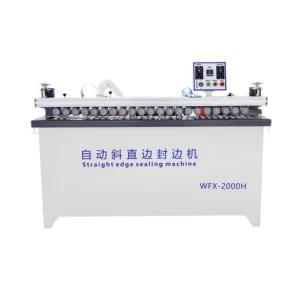
Fast-Dispatch Edge Banding — stocked DW3000 units ship with destination voltage, plug type, and control language verified before the crate is sealed.
Technical Specifications
| Parameter |
Value |
| Model |
DW3000 |
| Product Type |
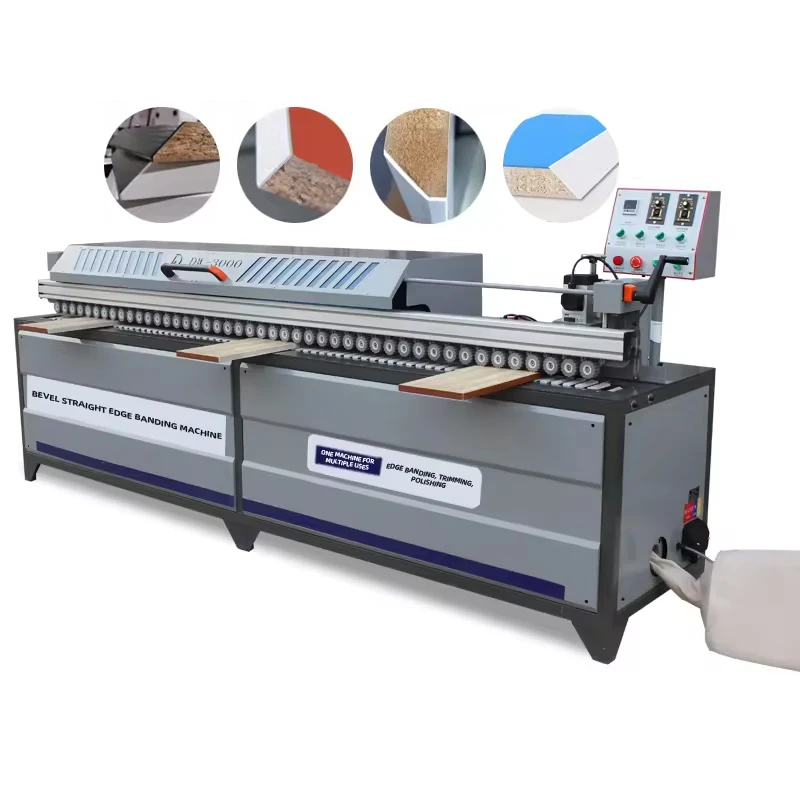
45 Degree Oblique Straight Edge Banding Machine |
| Total Power |
11 kW |
| Voltage |
380V / 415V (custom configurable) |
| Pre-milled Motor |
2.2 kW |
| Heating Power |
2.2 kW × 2 (double heat gun) |
| Trimming Power |
2.2 kW × 2 (3 spindle trimming motors) |
| Polishing Power |
0.4 kW × 2 |
| Vacuum Power |
550 W |
| Transmission Power |
180 W |
| Feed Speed |
0–12 m/min |
| Glue Pot Capacity |
4000 ml |
| Edge Banding Height |
0–50 mm |
| Edge Banding Thickness |
0.3–3 mm |
| Minimum Sheet Length |
30 cm |
| Minimum Sheet Width |
15 cm |
| Pressure Wheel Groups |
8 groups (oblique angle adjustable 30–90°) |
| Feeding Belt |
Double cylinder feeding belt |
| Edge Scraper |
Flexible edge scraper for glue-line cleaning |
| Air Source Pressure |
0.5–0.7 MPa |
| Product Dimensions (L×W×H) |
299 × 65 × 130 cm |
| Net Weight |
430 kg |
| Standards |
CE |
Application Suitability
| Application |
Material or Output |
| Cabinet door and carcass edge finishing |
MDF, particleboard with PVC and ABS banding |
| Custom furniture panel edging |
Plywood and melamine-faced board |
| Small-batch bevel and straight profiles |
Solid wood panels with veneer edge banding |
| Workshop transitioning from manual trimming |
Board components requiring 30–90° oblique or straight edge treatment |
| Joinery startup scaling to machine-fed output |
Panels from 30 cm minimum length at varied thickness |
Why the Voltage Question Must Come Before the Price Tag
Every 45 degree edge banding machine in stock leaves our floor only after the buyer's electrical supply is photographed and confirmed.
I watched a custom cabinet shop in Shandong lose three full weeks of production because a 380V machine was plugged into a 220V line on arrival — the breaker tripped instantly, and the transformer had to be freighted in from another province. That single oversight stalled an entire assembly line and cost more in downtime than the machine itself [NEED_CITE: voltage and frequency standards by export market]. When a small workshop is ordering its first edge bander, the excitement around feed speed and trimming stations often pushes electrical compatibility to the bottom of the checklist. Yet for a compact unit like the DW3000, confirming whether the facility runs three-phase 380V, 415V, or requires a different configuration is the most consequential decision in the entire purchase. A machine that cannot power on is not a delayed project — it is a stopped factory.

Stocked for Small Workshops That Cannot Wait on Production Runs
The DW3000 occupies the entry-level tier of our oblique-straight edge banding range, and it is held in ready stock precisely because small joinery shops and startup cabinet makers rarely have the buffer time to absorb multi-week build cycles. When a workshop is moving from a hand-held trimmer to a machine-fed process, the gap between ordering and commissioning directly affects how quickly first revenue arrives. Holding this 45 degree edge banding machine in stock shortens that gap, allowing buyers to align delivery with their own facility readiness rather than the other way around.
Compact Footprint Without Sacrificing the Full Edge-Banding Sequence
Despite a 299 cm machine length, the DW3000 runs the complete sequence — pre-milling, adjustable-angle edge banding, trimming, scraping, and polishing — in a single pass. For a workshop operating inside a limited bay, this means the edge bander slots between a panel saw and a boring station without requiring a dedicated zone. The eight pressure wheel groups adjust from 30 to 90 degrees, so the same unit handles both bevel and straight profiles without a second machine or a tooling swap that interrupts the workday.
Reading the Spec Sheet Against Real Board Behavior
The 0–12 m/min feed speed range lets operators dial down for delicate veneer banding and open up for PVC runs on particleboard, keeping glue activation consistent through the double heat gun arrangement. Pre-milling at 2.2 kW removes saw marks before the banding station, which directly affects the visibility of the glue line on finished panels — a factor that determines whether a cabinet door passes visual inspection or gets sent back for rework [NEED_CITE: effect of pre-milling on edge band adhesion quality]. Three spindle trimming motors handle end trimming and flush trimming in sequence, reducing the chip-out that single-motor setups leave on melamine surfaces. The flexible edge scraper then cleans residual adhesive in the same pass, so panels exit the machine ready for assembly rather than requiring a secondary hand-scraping step.
The Cost of Skipping Configuration Checks at Order Stage
When an entry-level edge bander arrives with a control panel printed in a language the operator cannot read, the machine sits idle while translated instructions are sourced — a delay that has nothing to do with mechanical capability and everything to do with paperwork that was never requested. Similarly, a glue pot calibrated for one climate zone may struggle to maintain stable adhesive viscosity in another, causing banding lift on the first cold morning of autumn [NEED_CITE: hot melt adhesive performance across temperature zones]. These are not manufacturing defects; they are specification gaps that surface only after the crate is opened. For a small workshop without a backup edge bander, each gap represents days of lost output and unhappy customers waiting on delayed cabinet deliveries.
What Makes This Purchase Path Different
Voltage and plug confirmation happens before dispatch, not after arrival — every DW3000 ships with a signed electrical verification sheet matching the destination facility's supply. The control panel language is set to the operator's preference at the factory, so the first power-on is also the first productive run. Pre-shipment testing uses actual board samples at the buyer's specified thickness, and the test record travels inside the crate alongside the machine. CE documentation and ISO 9001 certification are included as standard, removing customs ambiguity at the port of entry. The entire unit arrives with operation and maintenance manuals in the agreed language, matched to the specific configuration that was built and tested.
Documentation & Verification
- CE declaration of conformity covering the DW3000 edge banding machine
- Voltage confirmation sheet signed against buyer's facility supply before crating
- Factory test record using buyer's specified board thickness and banding material
- Operation and maintenance manual in the agreed operator language
- Packing photographs documenting machine condition at point of dispatch
Installation, Commissioning & Support
- 380V/415V three-phase dedicated circuit required; confirm breaker rating against 11 kW total draw
- Air supply line rated 0.5–0.7 MPa connected before first run to activate pressure wheel cylinders
- Machine arrives fully assembled; only infeed/outfeed support tables require on-site alignment
- Double heat gun warm-up sequence must complete before first panel enters to ensure adhesive consistency
- Glue pot 4000 ml capacity supports a full shift of standard PVC banding before refill is needed
- Flexible scraper blade inspection recommended weekly to maintain glue-line removal quality
Before You Request a Quote
Tell us the board materials you process most often — MDF, particleboard, plywood, or solid wood — and the edge banding type and thickness range you plan to run. Confirm your workshop's voltage, phase, and frequency from the main distribution panel, and let us know the preferred language for the control panel and manuals. If you already have a panel saw or boring machine upstream, share the model so we can verify feed-height compatibility.
Frequently Asked Questions
Q: What voltage configurations are available from stock, and can single-phase be supplied?
A: Stocked DW3000 units are configured for three-phase 380V or 415V. Before dispatch, we verify your facility's exact supply against our voltage confirmation sheet. Single-phase or alternative voltage setups require a configuration adjustment, which adds a short lead time but ensures the machine powers on correctly the moment it is connected.
Q: How do I switch between oblique and straight edge banding on this machine?
A: The eight pressure wheel groups adjust from 30 to 90 degrees via a manual angle-setting mechanism on the frame. Switching between a bevel profile and a straight edge takes a few minutes of adjustment without removing or replacing tooling, so you can alternate profiles within the same production batch without significant downtime.
Q: How fast can a stocked unit ship compared to a custom configuration?
A: Ready-stock units with standard 380V or 415V configuration and default language panels can dispatch within days once voltage verification is complete. Orders requiring non-standard voltage, special plug types, or alternative control-panel languages follow a brief configuration cycle before shipping.
Q: Which edge banding materials and thicknesses does the DW3000 handle?
A: The machine processes PVC, ABS, melamine, and veneer edge banding in a thickness range of 0.3 to 3 mm. Banding height capacity runs from 0 to 50 mm, covering most standard cabinet and furniture panel profiles encountered in a small-to-mid-size workshop environment.
Q: What spare parts are included, and how are consumables reordered?
A: Each shipment includes a starter set of spare parts matched to the DW3000 configuration, listed in the packing documentation. Consumable items such as scraper blades and trimming cutters can be reordered directly through our supply channel using the parts list provided with your machine.