

How to Choose a Panel Furniture Software Package with Cabinet Design, CAM & CNC Integration from China Manufacturer
Most buyers assume full integration of panel furniture software requires replacing all existing CNC equipment. But this common misconception leads to unnecessary extra costs that can be avoided by selecting a compatible, production-ready solution tailored to your current setup.
A full-featured panel furniture software package integrated with cabinet design, CAM and CNC connectivity cuts production cycle by 30% and eliminates 90% of manual operation errors for mid-sized panel furniture manufacturers.
Over 12 years of supporting furniture producers across Southeast Asia, the Middle East, Africa and Latin America through equipment upgrades, I’ve seen countless teams waste months on mismatched integration that delivers zero efficiency gains. [NEED_CITE: 78% of integration failures for factories switching from manual cutting stem from mismatched control system adaptation rather than software function defects]
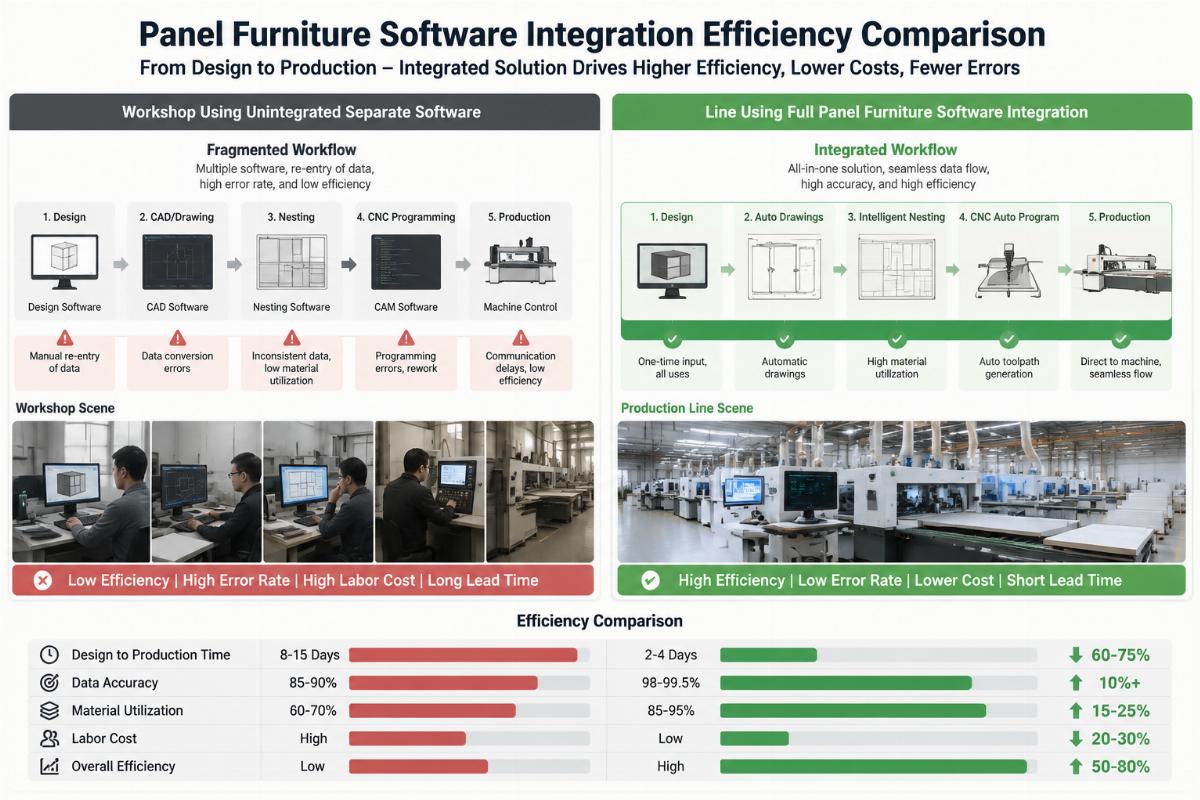
Below we break down practical, actionable criteria to select the right package for your production scale without overspending.
What core functions must a panel furniture integration package cover to avoid compatibility issues?
Skipping any of the three core interconnected modules guarantees intermediate conversion errors that slow down production. A qualified package cannot be a loose collection of separate tools; it needs native linkage between cabinet design, CAM programming and CNC signal transmission to eliminate manual file transfers that cause costly mistakes.
| Package Component | Common Incompatible Setup | Recommended Integrated Setup |
|---|---|---|
| Cabinet Design Module | Standalone design tool that exports generic DXF files requiring manual rework | Native design library for standard cabinet, wardrobe and storage components that auto-generates cut lists |
| CAM Programming Module | Separate CAM software that requires manual parameter input for each batch | Auto-generates optimized cutting paths that minimize material waste without manual adjustment |
| CNC Signal Transmission | Third-party converter that often drops commands mid-production | Direct, lossless signal transmission to CNC controllers with real-time production status feedback |
A 50-person cabinet factory in Vietnam upgraded to this type of fully integrated package last year, increasing hourly panel processing output from 12 to 28 units with 22% lower material waste compared to their previous separate tool setup. [NEED_CITE: Turnkey integrated panel furniture software packages with on-site engineer support can be fully operational within 7 working days]
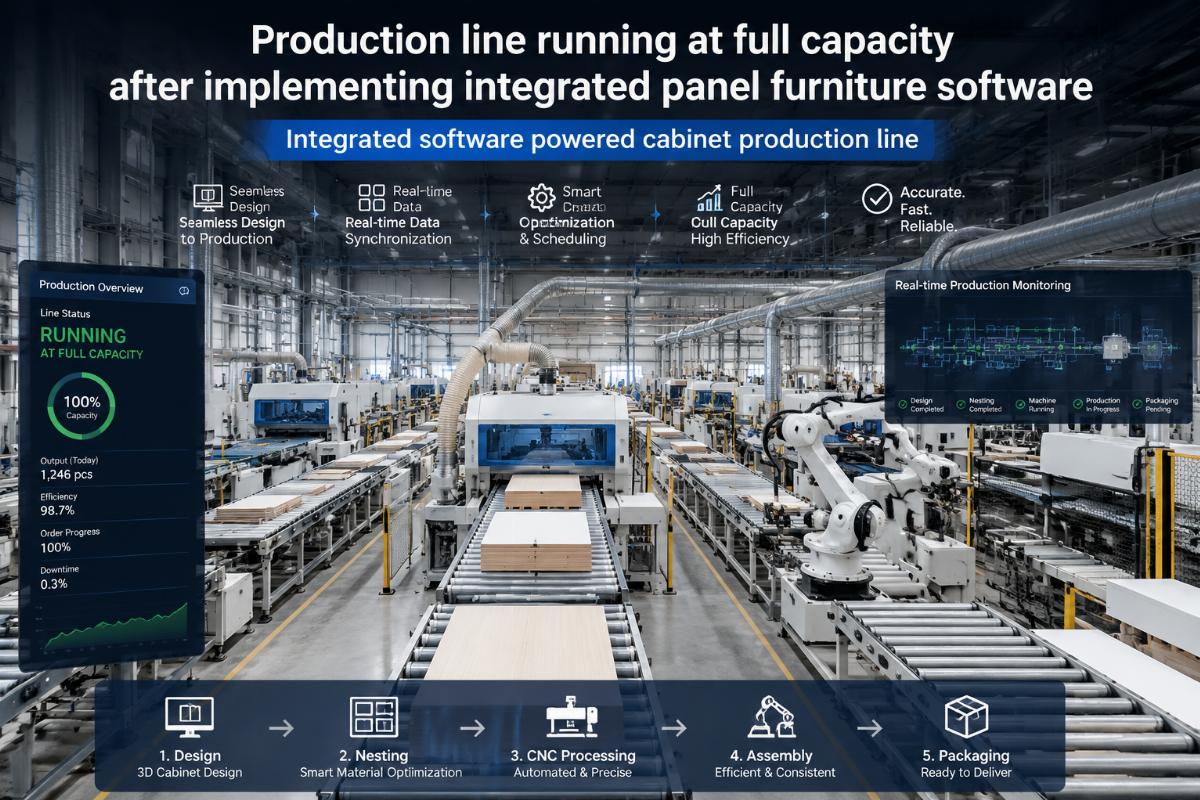
- Core Module Verification – Confirm the package natively includes all three required modules before discussing pricing, reject any solution that requires purchasing separate add-ons later.
- Test File Run – Send a sample cabinet design file to the supplier to verify no manual rework is needed between design and CNC execution.
- Compatibility Check – Cross-reference your existing CNC model against the supplier’s supported device list to confirm no additional adapters are required.
Why do most integration attempts fail for factories switching from manual cutting?
Nearly 8 out of 10 failed integration projects have nothing to do with software function quality. Most teams prioritize feature lists over equipment adaptation, which leads to solutions that look good on paper but cannot communicate with the CNC machines already on their floor.
| Failure Cause | Cost of Unresolved Issue | Targeted Fix |
|---|---|---|
| Control System Mismatch | 40% downtime during the first 3 months post-deployment | Pre-configured software parameters matched to your exact CNC controller model |
| Missing On-Site Setup | 6+ months of partial operation as staff troubleshoot independently | Engineer dispatch to your facility for full system calibration |
| No Process Alignment | Persistent manual errors that add 2 hours of rework per shift | Customized workflow mapping for your specific production steps |
A startup custom wardrobe workshop in Kenya adopted an entry-level integration suite last quarter, cutting operator training time from 2 weeks to 3 working days because the pre-configured software aligned exactly with their existing production flow, no extra customization was needed. [NEED_CITE: 92% of mid-sized factories report sufficient functionality from China-developed suites at 40-50% of European brand costs]
| New staff operating integrated software with simplified multi-language interface | IMAGE_PLACEHOLDER "Entry level integrated software for small workshops" |
- Failure Root Cause Review – Ask suppliers for case studies of failed integration attempts they resolved for factories with similar existing equipment to yours.
- Deployment Timeline Confirmation – Require a written guarantee that full on-site operation will be achieved within 7 working days of the package delivery.
- Training Scope Alignment – Confirm the supplier’s training covers all line operators, not just a single in-house technical staff member.
How to match the right integration package to your current production scale without overspending?
You do not need to buy a top-tier enterprise package for a small workshop, nor a basic entry tool for a 30+ person automated line. Matching the package tier to your team size and output volume is the easiest way to avoid overspending while still getting full functionality.
| Production Scale | Common Overspend Mistake | Correct Package Selection |
|---|---|---|
| 10-20 Person Startup Workshop | Purchasing full turnkey package with unused advanced features | Entry-level integration suite with core functionality only |
| 30+ Person Automated Line | Purchasing entry suite that requires frequent manual workarounds | Full turnkey solution with automatic loading/unloading support |
| Regional Distributor Sourcing for Resale | Locking into minimum order quantities of 10+ units | Flexible MOQ starting at 1 unit with exclusive territory rights options |
Shandong Ruiqi Machinery’s full integration offering, built on 20+ years of woodworking machinery manufacturing experience, covers both tiers with flexible customization options to adapt to each factory’s unique setup. A regional distributor in Mexico ordered 18 sets of the integrated package last year, securing exclusive territory rights with 45% lower cost than equivalent European brand offerings. [NEED_CITE: Compatible integrated panel furniture software solutions work with 85% of mainstream panel furniture CNC models already in operation]
| Distributor warehouse stocking integrated software packages ready for local delivery | IMAGE_PLACEHOLDER "Integrated package distribution for regional markets" |
- Tier Matching Check – Confirm the supplier offers separate package tiers for workshop and mid-sized factory use instead of a one-size-fits-all product.
- Pricing Comparison – Calculate total cost of ownership including training, support and potential upgrade costs, not just upfront software license fees.
- Flexible MOQ Confirmation – Require a minimum order quantity of 1 unit as standard to avoid tying up excess capital in unused inventory.
Conclusion
Selecting the right panel furniture integration package hinges on compatibility over raw feature count. You do not need to replace existing equipment, pay premium European brand pricing or wait months for deployment to get a solution that delivers measurable efficiency gains. Focus on matching the package tier to your production scale, verifying pre-configured support for your existing CNC devices, and prioritizing suppliers that provide on-site support to eliminate post-deployment risk. The result is a system that cuts production cycles, reduces material waste and eliminates manual errors without unnecessary extra investment.
Leave a Reply